
Vessels
There are a number of measures that should be taken to minimise or eliminate the risk of divers or snorkellers being injured or killed by moving vessels.
Examples include:
- fitting propeller guards to tenders
- using buoys and markers to separate diving activity from vessels
- using flags, day shapes and lights to indicate that divers and snorkellers are present
- appointing lookouts to maintain a watch and form part of the communication system
- ensuring that workers are familiar with sites and can navigate
- consulting and advising other persons in the vicinity of where and when diving is occurring
- implementing safe systems of work, such as shutting off engines when divers are alongside
- ensuring divers using surface supplied breathing apparatus have redundant breathing systems so they can surface safely if a vessel damages their main air supply.
Appropriate powered tender vessels
There have been a number of incidents where the success of the rescue attempt has been compromised by the use of inappropriate vessels for the rescue of divers and snorkellers. There is also a risk of divers and snorkellers receiving severe injuries by coming into contact with unguarded propellers on rescue tender vessels.
The Recreational Diving, Recreational Technical Diving and Snorkelling Code of Practice 2024 (PDF, 0.61 MB) states in section 2.4 Rescue of a person diving/snorkelling; "an appropriate powered tender vessel should be maintained in a ready condition, in the water for the purpose of rescue during diving or snorkelling operations".
Availability
If no powered tender is provided, then other ways must be adopted and followed that give the same level of protection against the risk. This can be tested by considering comparable rescue scenarios and establishing whether the system adopted provides a system of rescue that gives the same level of protection as having a powered tender vessel.
An example of this may be when the main diving vessel provides the same speed, availability and effectiveness of rescue as having a separate tender vessel. Typically, larger vessels and sailing vessels would not be able to provide the same speed, availability and effectiveness of rescue as having a separate tender vessel.
Appropriateness
Any vessel used for diving and snorkelling rescue purposes must be appropriate for the task. The Managing the Risks of Plant in the Workplace Code of Practice 2021 states:
"You should ensure plant is only used where it is capable of performing safely within the design criteria and manufacturer's instructions."
Factors to consider include:
- manoeuvrability and speed
- draft
- entry and egress (consideration should be given to potentially unconscious persons, tender crewing levels and stability)
- line of sight between master of the tender and persons in the water
- ability to safely transport an unconscious person
- readiness for use.
Examples of appropriate tender styles include inflatable style vessels. Examples of inappropriate vessels include high-sided vessels and vessels with limited access points.
Propeller guards
The Managing the Risks of Plant in the Workplace Code of Practice 2021 states: "Where appropriate, risks associated with some hazards should be minimised through the use of guarding". It also states "The employer should ensure moving parts have suitable guarding. Where guarding of moving parts does not prevent the risk of entanglement, persons should not operate or pass in close proximity to the plant unless a barricade or safe system of work has been implemented to prevent or minimise the risk".
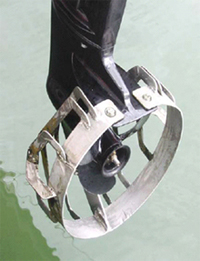
Plate 2: An example of a guarded outboard propeller
The Recreational Diving, Recreational Technical Diving and Snorkelling Code of Practice 2024 states in section 6.8 Plant; "adequate and appropriate guarding is installed to prevent people coming into contact with moving parts, for example prop guards are attached to the motors of tenders and rescue vessels".
Powered vessels used for rescue purposes, and other vessels required to manoeuvre amongst divers and snorkellers should have propeller guards where appropriate.
Typically, it is appropriate for outboard engines equal to or less than 30 hp to have permanently mounted propeller guards. It may not be practical to fit propeller guards to outboard engines greater than 30 hp for reasons of cavitation.
Where guarding is not practical, the employer should consider whether the vessel and engine type is suitable for use as a rescue vessel or to manoeuvre amongst divers and snorkellers. Other systems adopted must give the same level of protection against the risk. An example of this may be the physical separation of the propeller from divers and snorkellers where a tender vessel uses a marked and buoyed channel; or the use of guarded auxiliary outboard motor less than 30hp for manoeuvring amongst divers and snorkellers.