
Managing the risks
The transition from workplace exposure standards (WES) to workplace exposure limits (WEL) does not change a person conducting a business or undertaking’s duty to manage risks from airborne contaminants. WELs are an important tool for assessing and controlling worker exposure, but they should not be relied upon as the sole means of protecting health. Exposure risks must be identified, assessed and controlled using a comprehensive risk management approach.
The most effective way to manage a risk is to completely remove the hazard from the workplace. This means eliminating the generation or release of hazardous dusts, gases, fumes, vapours, mists and fibres wherever reasonably practicable.
In many workplaces, elimination may not be reasonably practicable. Where this occurs, duty holders must minimise risks so far as is reasonably practicable by implementing effective control measures. The preferred approach is to select controls in accordance with the hierarchy of controls, which ranks risk controls from the most effective to the least effective.
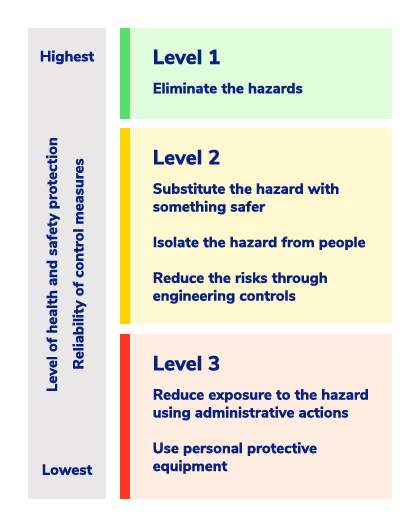
Higher-order controls, such as substitution, isolation and engineering controls, should be prioritised because they reduce exposure at the source. Administrative controls and personal protective equipment (PPE) should only be used to supplement higher-order controls, not as the primary means of managing exposure.
The transition to WELs provides an opportunity for workplaces to review existing risk controls, exposure monitoring programs and health monitoring arrangements to ensure they remain effective and continue to protect workers from airborne contaminants.
Compliance with a WEL does not automatically mean that risk has been eliminated, particularly for substances that may cause serious health effects such as sensitisation, carcinogenicity or other long-term adverse health outcomes.
Further information on specific risk management measures, the hierarchy of controls, exposure monitoring and health monitoring can be accessed through the following resources and links:
- Managing risks
- How to manage work health and safety risks Code of Practice 2021 (PDF, 0.6 MB)
- Managing risks of hazardous chemicals in the workplace Code of Practice 2021 (PDF, 1.21 MB)
Air monitoring
Air monitoring, also referred to as exposure monitoring, is a valuable tool for assessing whether workers are being exposed to hazardous substances and whether control measures are effectively minimising risks.
Air monitoring involves the measurement of airborne contaminants, such as dusts, fumes, gases, vapours, mists and fibres, within a worker's breathing zone. Personal monitoring results can be compared against applicable WELs to help determine whether exposures are being adequately controlled and whether additional risk management actions are required.
Air monitoring should be considered when:
- There is uncertainty about the level of worker exposure.
- It is necessary to determine whether a WEL may be exceeded.
- Changes to a WEL have occurred and workplaces need to assess the impact on existing exposure controls.
- New processes, substances or work practices are introduced.
- There is a need to verify the effectiveness of implemented control measures.
- Health effects associated with exposure could be serious, irreversible or difficult to detect in their early stages.
The introduction of revised WELs may result in some airborne contaminants having lower exposure limits than previously applied. As a result, workplaces should review existing air monitoring data, risk assessments and control measures to determine whether further monitoring or control improvements are necessary.
Air monitoring is only one component of an effective risk management process.
Monitoring results should be used alongside hazard identification, risk assessment, implementation of the hierarchy of controls, and where required, health monitoring, to ensure workers are protected from exposure to hazardous airborne contaminants.
Further information on when air monitoring is required, monitoring methods, interpretation of results and regulatory requirements can be accessed through the following resources and links:
- Guide for PCBUs: Air monitoring and the workplace exposure limits for airborne contaminants
- Engaging an occupational hygienist | Safe Work Australia Airborne contaminants - Information for occupational hygienists/technical experts
A competent person such as occupational hygienist can carry out personal air monitoring.
Health monitoring
Health monitoring involves assessing a worker's health to identify any adverse effects resulting from exposure to certain substances. It helps PCBUs determine whether workplace control measures are effective and whether additional action is needed to protect workers.
Health monitoring is not a substitute for implementing the hierarchy of controls and must be carried out by, or under the supervision of, a registered medical practitioner with experience in health monitoring.