
Worker sustains fatal injuries after falling from a ladder
MAY CONTAIN DISTRESSING CONTENT TO SOME READERS
In 2025, a worker sustained fatal injuries when they fell from a ladder while accessing a residential roof. It appears the worker was installing a satellite internet service at the residential property when they have fallen approximately 3.8 metres from a ladder. The worker succumbed to the fatal injuries on-site. Investigations have identified that the ladder may not have been secured to the structure prior to accessing the roof.
These findings are not yet confirmed, and investigations are continuing into the exact cause.
Safety issues
Falls from ladders have resulted in a significant number of serious and fatal injuries, even when working at relatively low heights. While ladders are often considered to be the first option when working at heights, they should only be considered after safer alternatives have been considered first and found to be not reasonably practicable.
Work involving ladders often leads to falls because of:
- ladder instability – not secured correctly
- the ladder being damaged/unsuitable
- movement on or off the ladder
- the type of work carried out
- unsafe use, including the person leaning out to the side of the ladder (refer to some examples shown in Figure 1).
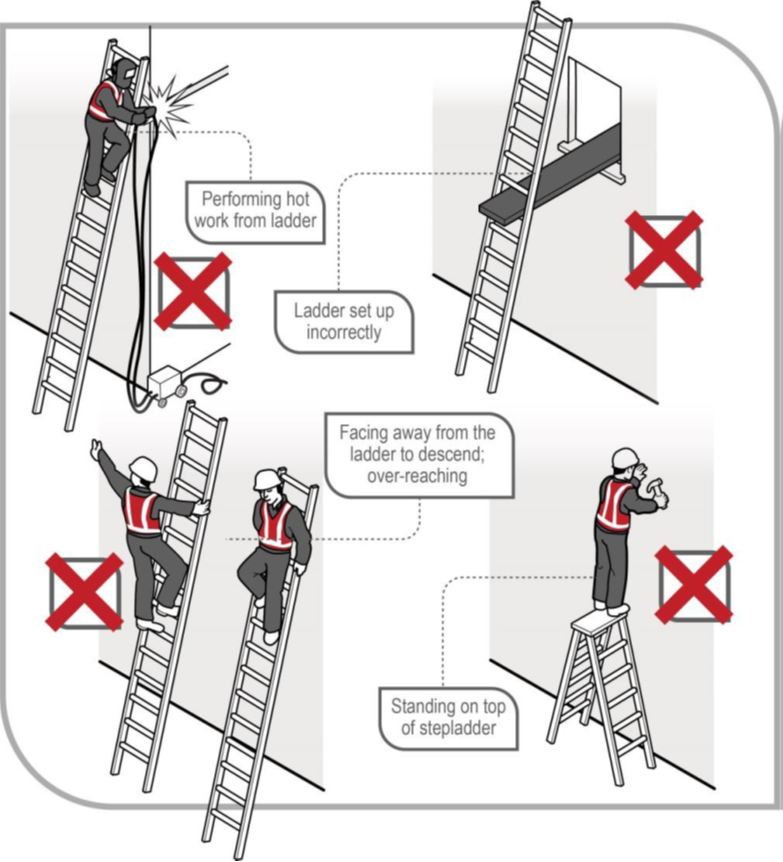
Figure 1 Examples of unsafe ladder use
Ways to manage health and safety
Effective risk management starts with a commitment to health and safety from those who manage the business. If an incident occurs, you will need to show the regulator that you have used an effective risk management process. This responsibility is covered by your primary duty of care in the Work Health and Safety Act 2011.
Use the hierarchy of controls to help decide how to eliminate and reduce risks in your place of work. The hierarchy of controls ranks types of control methods from the highest level of protection and reliability to the lowest. It is a step-by-step approach to eliminating or reducing risks. You must work through the hierarchy of controls when managing risks, with the aim of eliminating the hazard, which is the most effective control.
Possible control measures to prevent similar incidents
As a PCBU, you must manage risks to health and safety associated with a fall by a person from one level to another that is reasonably likely to cause injury to the person or any other person.
You must ensure, so far as is reasonably practicable, that any work involving a risk of a fall is carried out on the ground or on a solid construction. If it is not reasonably practicable for you to eliminate the risk of a fall by working on the ground or on a solid construction, you must minimise the risk of a fall by providing adequate protection against the risk.
Adequate protection against the risk is provided if you provide and maintain a safe system of work, including by:
- providing a fall prevention device, or
- if it is not reasonably practicable to provide a fall prevention device, providing a work positioning system, or
- if it not reasonably practicable to provide a work positioning system, providing a fall arrest system
- if a risk remains after considering all of the control measures mentioned above, you must minimise the remaining risk, so far as is reasonably practicable, by implementing administrative controls.
Ladders are considered to be an administrative control.
Further guidance and definitions of the various terms used above can be found in the Part 4.4 of the Work Health and Safety Regulation 2011 and the Managing the risk of falls at workplaces Code of Practice 2021 (PDF, 3.9 MB).
Construction work vs work of a minor nature
Queensland WHS legislation requires consideration of what is “reasonably practicable” when applying the hierarchy of controls to identify and implement the most effective measures to minimise health and safety risks for a specific task or activity. Just because a task or activity is deemed as quick and/or does not meet the definition of ‘construction work’, does not mean it is low risk. Risk of injury from falls must be adequately assessed and compliant, and adequate controls measures implemented prior to work commencing.
Section 289 of the Work Health and Safety Regulation 2011 details what is classified as ‘construction work’, for the purpose of applying the Construction Work Regulations, with specific requirements to control the risks of falls, including the use of ladders.
What about works that do not meet the definition of construction work?
Part 4.4 of the WHS Regulation requires that risk of injury from falls be managed for all work activities, whether construction work or not.
Safe Work Australia provides further guidance on determining what classifies as works of a minor nature, which also bears relevance to what is reasonably practicable in different tasks (physical requirements and duration of tasks), via an information sheet (Safe Work Australia - Construction Work, Work of a Minor Nature, Information Sheet).
Unfortunately, many roof installation works are often incorrectly labelled as quick, low risk tasks and the corresponding risks are not adequately managed. The Safe Work Australia information sheet includes: ‘Work of a minor nature’ is usually but not always low risk. ‘Work of a minor nature’ may still be hazardous and must be carried out in full compliance with all applicable provisions of the work health and safety legislation. For example, if the work is carried out where there is a risk of a fall then those risks must be managed in accordance with Part 4.4 of the WHS Regulations.’
Managing risks when working at height with ladders
The most effective control measure is to eliminate the risk of a fall such by working on the ground or from a solid construction. The solid construction must have a safe means for people to enter and exit and to move around the work area, for example permanently installed platforms, ramps, stairways or fixed ladders.
If the work cannot be carried out from ground-level or a solid construction, then you will need to, so far as is reasonably practicable, minimise the risk of a fall. Hazards associated with working at height (where ladders may be used) that involve a risk of falling must be identified and controlled. The following control measures should be considered when working at height:
- using higher order engineering controls such as purpose designed scaffold systems, mobile scaffold or portable stair system that incorporates work platforms or landings and guardrails. If scaffolding is used, ensuring it is erected by a competent person and complies with the Scaffolding Code of Practice 2021 (PDF, 1.75 MB), with safe access and egress from the scaffold provided.
- a work positioning system, such as restraint technique, whereby the user wears a harness connected by a lanyard to an anchor point to physically prevent the person from reaching a position at which there is a risk of a fall.
- a fall arrest system, such as a catch platform, safety net or individual fall arrest system.
- elevating work platforms (EWPs) enable workers to remain within the EWP and avoid standing on the surface. The safe operation of EWPs also relies on safe work procedures (i.e. administrative controls), which includes ensuring operators hold the relevant High Risk Work Licence (HRWL) - where required - to operate the EWP.
- depending on the specific task and how it is carried out, step platforms (see Figure 2) may provide an improved level of fall protection over traditional step or single ladders as they include a small working platform and a partial handrail.

Figure 2: A step platform can provide a stable work surface
If a ladder is adopted as the means of access:
- implementing a safe system of work when using ladders that considers:
- the design, condition and layout of elevated work areas, including the distance of a potential fall
- positioning and setting up of ladders. Before setting up a ladder, it should be inspected for visible damage or faults, for example broken rungs, stiles and feet. Faulty or damaged ladders must be removed from service. When setting up a ladder you should check that:
- the ladder is the correct height for the work to avoid over-reaching or stretching
- locking devices on the ladder are secure
- the ladder is not placed so that the weight of the ladder and any person using the ladder is supported by the rungs.
- setting up a ladder on a solid and stable surface, and to prevent the ladder from slipping.
- Single and extension ladders can be prevented from slipping by:
- ensuring the ladder has non-slip feet
- placing ladders at a slope of 4:1 (the distance between the ladder base and the supporting structure should be about one metre for every four metres of working ladder height)
- securing ladders at the top or bottom, or if necessary, at both ends (see Figure 3)
- When accessing roofs with gutters, consider using proprietary tools/systems that secure the ladder’s stiles to the gutter.

Figure 3: Examples of effectively securing a ladder
- step ladders should be set up in the fully opened position and may require a second person to ‘foot’ the ladder for added stability.
- where single or extension ladders are used for entry and exit, you should check that:
- there is a firm, stable work platform, free from obstructions to step onto from the ladder and the ladder is securely fixed
- the ladder extends at least one metre above the stepping-off point on the working platform
- fall protection is provided at the stepping-off point where people access the working platform.
- the load rating of ladders should have a load rating of at least 120 kg and be manufactured for industrial use. Domestic or ‘homemade’ ladders should not be selected for industrial use or for use on construction sites.
- the manufacturer’s recommendations on safe use should also be followed
- only light duty work is done using ladders, where three points of contact can by maintained and tools can be operated safely with one hand
- workers are also provided with appropriate information, training, instruction and supervision to perform the tasks safely (young, new or inexperienced workers may be unfamiliar with a task).
If a risk remains, it must be minimised so far as reasonably practicable by using personal protective equipment (PPE). For example, wearing slip-resistant footwear and using a tool belt or side pouch. Administrative control measures and PPE rely on human behaviour and supervision, and used on their own, tend to be least effective in minimising risks.
Control measures should be reviewed regularly to make sure they are effective and work as planned.
Good ladders are only part of the puzzle
Having a suitable, stable, and secure ladder is a great starting point for workers to access heights, but ladders are rarely used in isolation. You must also consider:
- How are materials/tools/waste transported to the work zone at height:
- Are workers carrying materials and waste on their shoulders (or other) to access the work at heights?
- Are workers climbing with tools in their hand, thereby not maintaining three points of contact to climb up/down safely?
- What control measures will minimise risks to health and safety once the worker leaves the ladder?
Remember to use ladders in combination with other control measures to minimise risks to the health and safety of workers. A thorough risk assessment completed in consultation with workers, and provision of appropriate training and supervision are key requirements to achieve this.
More Information
- Managing the risk of falls at workplaces Code of Practice 2021 (PDF, 3.9 MB)
- How to manage work health and safety risks Code of Practice 2021 (PDF, 0.6 MB)
- Scaffolding Code of Practice 2021 (PDF, 1.75 MB)
- Work at heights – construction
- Safe work method statements
- Managing fall risks on roofs in housing construction
- Heightened focus – eSAFE article
- Safe Work Australia - Construction Work, Work of a Minor Nature, Information Sheet
If this information has caused distress, there are services to help:
- Lifeline – 24/7 crisis support service, including phone, texting and chat services.
- Beyond Blue – information and support for anxiety, depression and suicide prevention for everyone in Australia.
- Black Dog Institute – research and resources on mental health in the workplace.
- SANE – helpline service, as well as resources on mental health.
Have you been affected by a workplace fatality, illness or serious injury?
For advice and support: