
Agriculture campaign report (October–December 2025)
Workplace Health and Safety Queensland (WHSQ) conducted an agriculture industry compliance campaign between October and December 2025, focusing on the priority hazard area of mobile plant, particularly tractors, quad bikes, side-by-side vehicles and worker interaction with plant. This campaign aimed to reduce fatalities and serious injuries by increasing industry awareness and assessing work health and safety compliance at agriculture businesses throughout Queensland.
From 2008 to 2023, mobile plant accounted for almost 70% of fatalities in Queensland's agriculture industry. The most common vehicles involved in fatalities were tractors, quad bikes, trucks and utility vehicles. Workers continue to experience serious injuries and fatalities involving mobile plant.
The campaign included two phases: phase one – education and awareness; phase two – inspector activities, including workplace inspections and compliance action.
Phase one - How we shared safety knowledge
Phase one of the campaign focused on education and awareness. We reached approximately 10,000 Queensland businesses by email, sharing targeted information and practical guidance materials.
After the campaign, we surveyed businesses to understand its effectiveness, impact and long-term value. The following insights are based on 228 survey responses:
- Less than half of respondents felt prepared for the audit.
- Most respondents reported that the campaign prompted them to take action, with routine safety inspections being the most common response. More than two-thirds of respondents indicated they had undertaken this activity.
- Some businesses also:
- improved consultation and communication with workers through regular toolbox talk and feedback mechanisms
- conducted training on traffic management plans
- improved the implementation of personal protective equipment (PPE).
Phase two - What we found
Phase two focused on workplace inspections. Inspectors assessed compliance and responded to non-compliance. Between October and December 2025, inspectors conducted 229 assessments of agriculture businesses across Queensland.
Inspectors used a standardised audit tool to ensure a fair and consistent approach.
Inspectors identified the following common areas of non-compliance:
Mobile plant and traffic management
- Traffic management was insufficient to prevent collision between mobile plant and pedestrians.
- Barriers or exclusion zones were missing or not good enough to separate people from moving plant.
- External contractors were not given clear instructions for loading and unloading.
- Signage was inadequate to clearly separate pedestrians and mobile plant.
Maintenance of mobile plant
- Seats and seatbelts were not adequately maintained.
- Mobile plant was not regularly inspected and checked before use.
- Roll-over protection structure (ROPS) was not provided.
Mobile plant guarding
- Power take off (PTO) shafts were inadequately guarded, exposing workers to risks.
- Guards on conveyors and other machinery were inadequate or missing, exposing workers to entrapment points.
Other
- Fall from heights controls were inadequate on elevated platforms (e.g. walkways between silos).
- Required electrical equipment safety checks (e.g. testing and tagging) were missing or out of date.
- Workers were not provided with information, training and instruction on the safe use of mobile plant.
- Processes for managing hazardous chemicals were ineffective, including safe handling, access to current safety information and provision of emergency equipment (e.g. eye wash stations).
- Emergency plans had not been prepared for the workplace (e.g. evacuation procedures).
What actions we took
Inspectors issued 413 enforcement notices as part of the campaign.
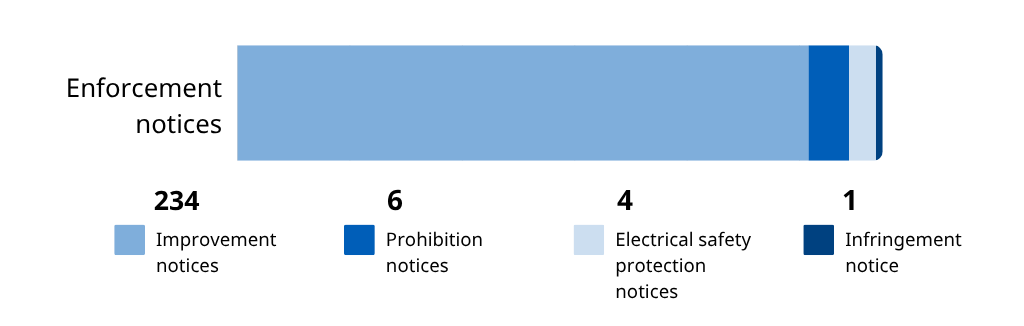
Businesses also rectified a further 58 non-compliances while inspectors were onsite. A $3000 infringement notice was issued for operating mobile plant too close to overhead electrical lines.
How to keep your workplace safe
To effectively manage risks from moving plant in agriculture workplaces, businesses should take the following actions:
- Install and maintain guarding correctly; repair or replace damaged guarding before use.
- Secure all mobile plant when not in use.
- Establish and maintain appropriate exclusion zones around mobile plant.
- Follow servicing and maintenance schedules consistently.
- Provide workers with clear information, training, and task-specific instructions.
- Verify and maintain worker competency, particularly for high-risk machinery.
- Ensure electrical equipment is tested and maintained at the required intervals by a competent person.
- Improve storage practices to prevent obstructions and trip hazards.
- Ensure all hazardous chemical containers are correctly labelled.
Safety is a shared responsibility. Whether you’re an employer, contractor, worker, or a dedicated health and safety representative—you play a role in keeping yourself and others safe.