
Retaining wall collapse on construction site
Issued: 26/05/2026
Last Updated: 26/05/2026
MAY CONTAIN DISTRESSING CONTENT TO SOME READERS
Purpose
This safety alert relates to a fatal incident involving the collapse of a concrete retaining wall. This alert highlights risk control measures that should be applied to prevent similar incidents and is relevant to builders, principal contractors, sub-contractors and workers who undertake excavations at or near the base of retaining walls and other structures.
Background
On 2 December 2025, two workers became trapped beneath a concrete retaining wall when it collapsed on a construction site in central Brisbane. Tragically one of the workers succumbed to his injuries and died, while the other worker was able to be rescued by emergency services.
The pre-existing retaining wall, measuring approximately 1.5 to two metres in height, was situated on the boundary of the construction site and the adjacent property. Early investigations indicate the workers had been preparing a shallow trench at the base of the retaining wall when approximately 10 to 12 metres of the retaining wall and supported earth collapsed. The trench had been created to cast a slab edge beam as part of a multi-level residential development.
Investigations are continuing.
These findings are not yet confirmed, and investigations are continuing into the exact cause.
Safety issues
Retaining wall collapses can occur suddenly and without warning, leaving little time for workers to escape the falling debris. The weight of retaining wall materials and supported earth can make retaining wall collapses particularly hazardous to those in the vicinity, who can be buried or crushed.
In Queensland, retaining walls greater than one metre in height require engineering design and certification. The design and certification will specify the conditions for which the retaining wall has been designed. If the existing ground conditions near the retaining wall are altered in any way, such that it is outside of the original certification, instability and failure could occur. As such, the presence of existing retaining walls and structures should be considered when designing new structures or excavations. This ensures the integrity and stability of the existing retaining wall or structure, the excavation, and the new structure, which ensures the new structure can be built safely.
Modern building designs often extend to the property boundary to maximise use of the available land size. This can result in construction works impacting the foundations of and earth surrounding adjacent structures, including other buildings and retaining walls. Despite this, structural engineering drawings are often silent on how to safely support adjacent buildings, retaining walls and other structures throughout each stage of construction. It is typically left to the builder to ensure appropriate temporary works and construction methods are used to control these risks after the building design has been finalised.
What causes retaining walls to fail?
Retaining walls often rely on the earth at the base of the wall to prevent the wall from sliding, overturning or collapsing. Disturbing this earth or performing excavations at the base of retaining walls can reduce or remove this support, leading to failure of the wall and collapse of the retained earth.
The following factors may contribute to the failure of a retaining wall:
- Undermining of the soil structure under or adjacent to the wall footing.
- Weakening/softening of the soil reducing its resistive forces.
- Water pressure pushing on the wall where drainage is inadequate.
- Extra (surcharge) loading on the top of the retained earth, increasing the weight/force pushing on the wall (e.g. vehicle travel, spoil storage, etc).
- Degradation of the wall structure.
Figures 1 to 5 (below) set out one of the common ways a retaining wall can fail:
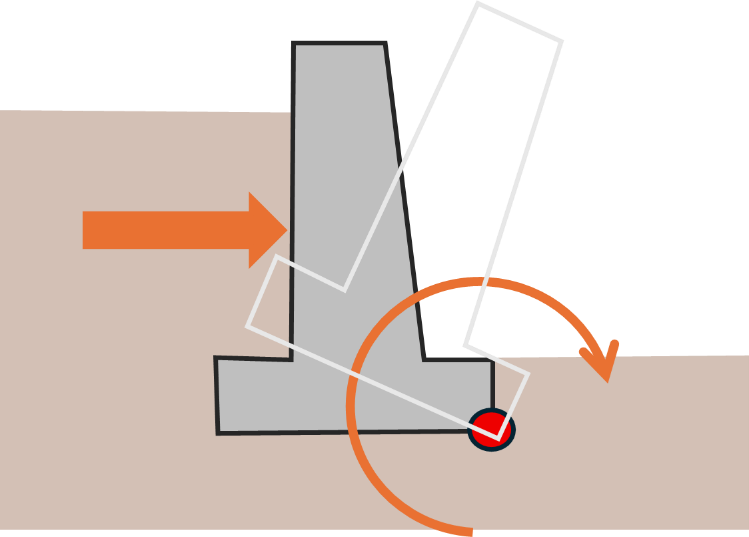
Figure 1: Typical retaining wall - showing soil forces pushing on wall, trying to slide or overturn it.
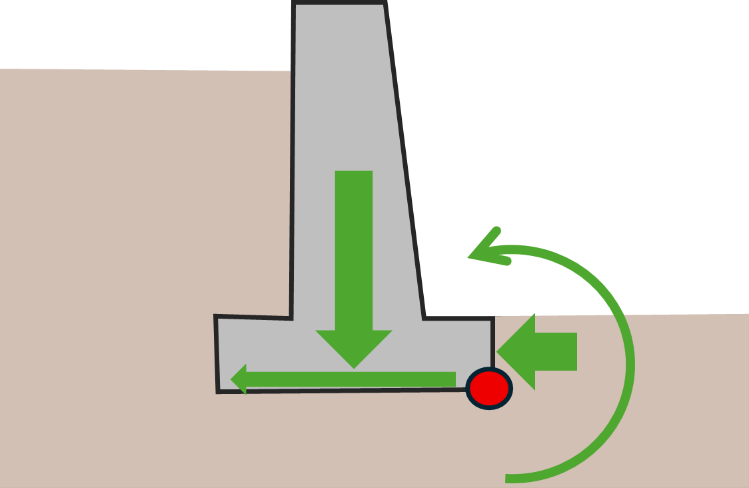
Figure 2: Wall mass/weight, friction and soil forces acting to prevent the wall sliding or overturning, thereby retaining the soil mass behind.
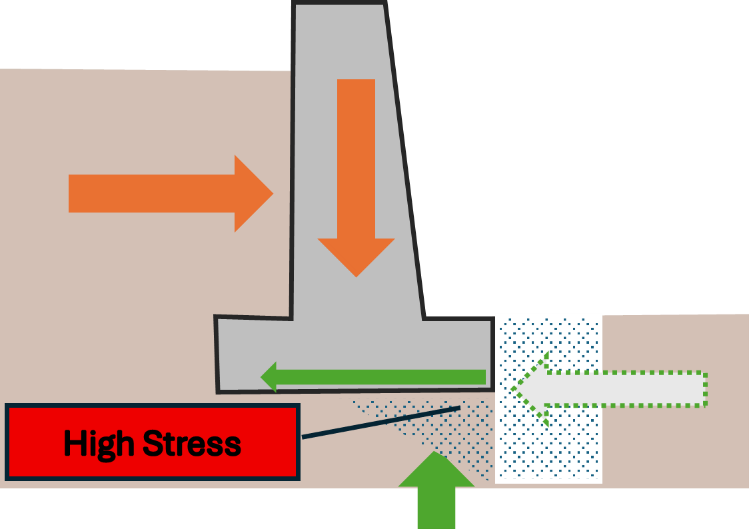
Figure 3: An excavation in front of the retaining wall changes the resisting forces, removing side stability from the footing area. With support removed, the mass/weight of the wall now becomes a force causing instability and failure. This will also likely overload the soil footing beneath the base of the retaining wall.
Figure 4: If the footing is deliberately undermined or the soil in the footing fails, the resisting/stabilising forces are removed.
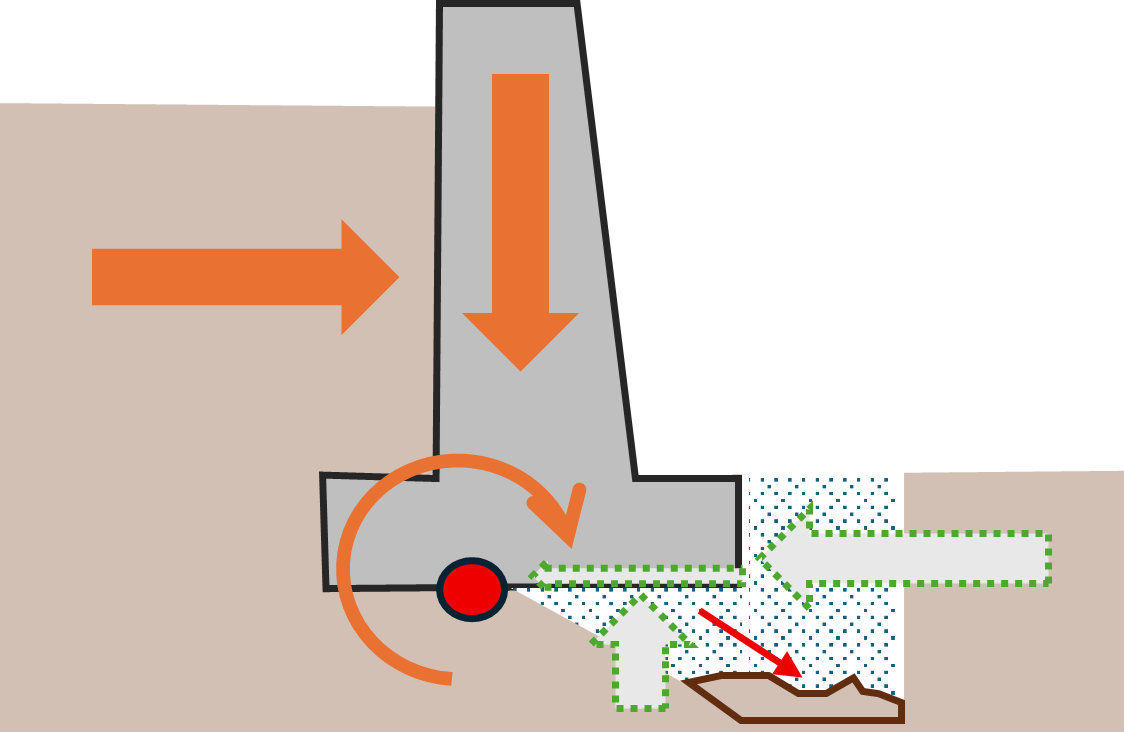
Figure 5: With the stabilising forces removed, the retaining wall will fail, either as a whole or by breaking into segments.
Action required
Persons conducting a business or undertaking (PCBUs) planning excavation works, must identify hazards and risks associated with the works and then, so far as is reasonably practicable, control these risks. This includes hazards and risks associated with excavation works in the vicinity of retaining walls and other structures.
Section 306 of the Work Health and Safety Regulation 2011 sets out requirements for trenches of at least 1.5 metres deep. However, excavations shallower than this may still pose serious risks to health and safety, especially if they are performed adjacent to existing buildings and structures, such as retaining walls.
To minimise the risks of retaining wall collapse, the following key points should be considered and implemented:
- Adequate investigation before excavating;
- Safe Systems of Work; and
- An effective Emergency Plan
1. Adequate investigation before excavating
The Excavation Work Code of Practice 2021 provides guidance on performing excavations adjacent to buildings or structures. Section 3.5 of the Excavation Work Code of Practice 2021 states:
- Excavation below the level of the footing of a structure, including retaining walls, that could affect the stability of the structure should be assessed by a competent person and secured by a ground support system which has been designed by a competent person. Suitable supports to brace the structure may also be required and should be identified by a competent person.
A competent person in this context would typically be a geotechnical engineer, who will assess and advise on the ground conditions and the impact of the excavation on existing structures.
The geotechnical engineer should produce a written reportthat includes:
- details of the existing soil conditions across different areas of the site and the maximum permissible (allowable) bearing capacity for these areas.
- acknowledgement of the physical conditions at the excavation site, including any adjacent structures, buildings, and retaining walls.
- an assessment of the integrity and stability of existing retaining walls, in consideration of any proposed changes to ground conditions and loadings, including any assumptions made.
- details of the assumed drainage and water behind or at the base of the retaining wall – originating from on-site and off-site sources, rain effects and dewatering requirements.
- limitations on the use of machinery or storage of equipment in the vicinity of the excavation or retaining wall that may affect its stability.
- the influence of existing structures including buildings, retaining walls, and underground services on the stability of new excavations, during the building process.
- any shoring or trench support requirements.
- implications of significant weather on changes to soil stability.
- the period to which it applies.
The findings from the geotechnical investigation should be used to highlight the potential risks from new excavations, applicable restrictions on any new excavations, and any earth support methods required (e.g. rock anchors, steel sheet piling, shotcrete, and other methods of earth stabilisation specified by a geotechnical engineer). Further consultation with civil or structural engineers should be undertaken to ensure planned excavations will not adversely affect existing structures, and the design of temporary support systems are appropriate
2. Safe systems of work
The Work Health and Safety Act 2011 requires the provision and maintenance of safe systems of work to minimise risks, so far as is reasonably practicable, at all stages of the project. This could include (but is not limited to) the following:
- Safety in design - using the information gained from the geotechnical engineer’s report to guide both the design and the building process. This includes informing the design of the new structure, any temporary support required for existing structures, staging of works, hold points, customised Safe Work Method Statements (SWMS) and other Safe Operating Procedures.
- Exclusion zones - ensuring workers never enter areas where they could be engulfed or struck by a collapsed excavation face or be at risk of being struck by another object that becomes unstable from the collapse of the excavation (e.g. a retaining wall, block wall or tilt-up panel that collapses).
- Information, training and instruction - must be provided to workers and others at the workplace associated with excavations. Topics should include: the nature and condition of the ground and working environment, any hazards and risks associated with planned excavation works and the measures in place to control these risks, weather conditions and actions required if adverse weather occurs, and acceptable static and dynamic loads near the excavation
3. Effective emergency plan
The Excavation Work Code of Practice 2021 states in section 3.8 that:
- A PCBU, such as an excavation contractor, at a workplace must ensure there is an emergency plan for the workplace. An emergency plan is a written set of instructions outlining what workers and others at the workplace should do in an emergency. The emergency plan should be capable of covering a range of unexpected emergency incidents, for example ground slip, engulfment, flooding, gas leaks and rescuing workers from an excavation. The PCBU must implement the emergency plan for the workplace in the event of an emergency.
It also goes on to state:
- To ensure a coordinated response to an emergency, the plan should be incorporated as part of the broader construction project emergency plan prepared by the principal contractor.
Emergency plans are implemented following an incident to reduce the level of harm; they do not prevent the incident from occurring. However, the emergency planning process and periodic drills/reviews can help highlight any complexities with the evacuation or retrieval of persons in the event of an incident, and thereby, may inform the need for stronger preventative controls.
The emergency plan must be relevant to the workplace hazards and risks, plant in use, the workplace location, and the persons present. PCBUs must ensure an emergency plan prepared for a workplace provides for information, training and instruction to relevant workers in relation to implementing the emergency. Emergency plans should be regularly reviewed and revised as required. Emergency drills are an effective way to educate workers, review the plan, and provide the basis for updates and improvements. An emergency plan should not simply refer to calling emergency services.
Further information regarding emergency plans can be found in section 3.8 of the Excavation Work Code of Practice 2021.