
Luffing tower cranes - extreme weather (wind) events
Issued: 19/01/2026
Last Updated: 19/01/2026
Purpose
This safety alert highlights the risk of booms being blown back on rope luffing tower cranes during extreme weather (wind) events and discusses ways to minimise the risk.
Background
In December last year, a 52 metre boom on a luffing tower crane was blown backwards on a construction site on the Gold Coast (refer Figures 1 and 2).
As a result, residents of the caravan park below the tower crane were evacuated. Once the crane was safely removed, the residents returned to the site.
In 2023 a similar incident occurred on a construction site. These incidents have considerable risk and can cause extensive property damage.
Since July 2018 there have been at least three similar incidents in other jurisdictions involving rope luffing tower cranes with two in Victoria and one in New South Wales. Except for one incident in Victoria, all other incidents occurred when the tower cranes were out of service with no operators in the crane cabin.
Contributing factors
The circumstances surrounding the latest Queensland incident included high wind speed and rapidly changing wind direction. When the wind direction changed, the upper part of the crane was unable to weathervane fast enough so that the boom tip was pointing downwind. Instead, before the crane was able to slew, strong wind blew onto the front of the boom, which is understood to have been stowed at an angle of approximately 70 degrees above horizontal. The force of the wind overcame the dead weight of the boom so that it pivoted backwards. As the boom impacted the buffers and/or rear of the crane it folded and became draped over the rear of the crane. The hook detached from the hook block punching a hole in the deck of a gantry below. Other parts of the crane were also significantly damaged.
The boom was stowed at a relatively high angle but within the crane manufacturer’s maximum allowable boom angle. This was done to ensure the boom would not strike an adjacent high rise building while in weathervane mode.
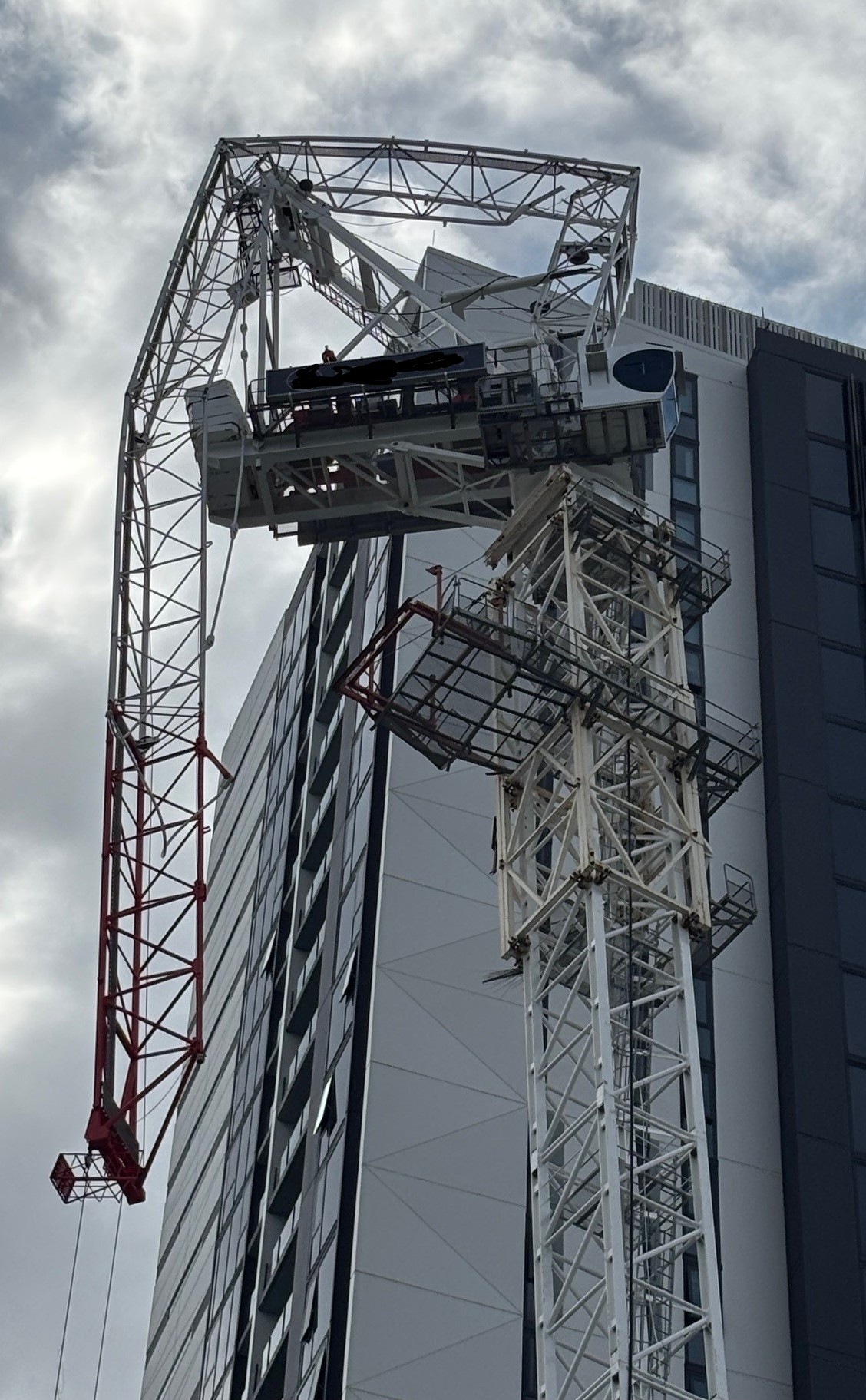
Figure 1
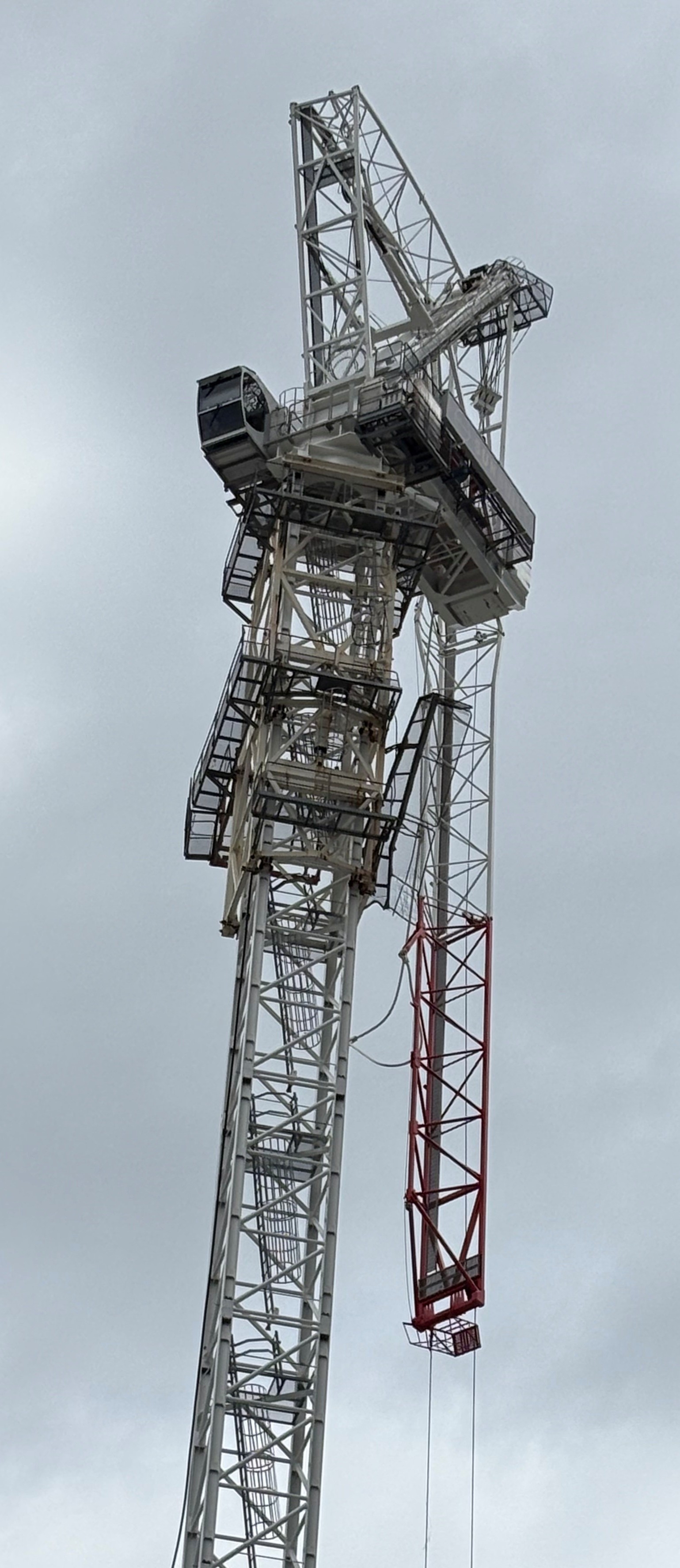
Figure 2
Action required
Out of service operation
Note: the term “weathervane” describes the ability for the top part of a tower crane i.e. boom, machine deck and counterweight, to free slew depending on the wind direction.
Wherever possible, tower cranes should be allowed to weathervane. In most cases, leaving a tower crane to weathervane allows the boom to slew around with the wind so that the boom follows the wind direction and the tip points downwind. In addition to reducing the risk of a boom being blown backwards, weathervaning reduces loads applied to the top of the tower thereby reducing stresses in the tower and boom. A tower crane that is permitted to weathervane can typically safely withstand higher winds than a crane where the upper part of the crane is locked in position (i.e. by applying the slew lock and/or tethering the boom to an anchorage). However, weathervaning may become less effective at reducing risks when the boom angle is relatively high, the wind speed is high and the wind rapidly changes direction.
When out of service, all tower cranes should be allowed to weathervane with the lowest practicable boom angle (i.e. maximum radius), unless there are physical obstructions or the crane manufacturer specifies otherwise. Physical obstructions may include other cranes, structures and buildings.
Wherever wind sails are specified by the tower crane manufacturer, for specific boom length and boom angle combinations, these are to be installed. In other circumstances where the weathervane angle cannot be reduced, wind sails should be evaluated for installation on the boom to improve weathervane responsiveness. However, unless the tower crane manufacturer states otherwise wind sails should be retractable as non-retractable wind sails can make the operation of some tower cranes hazardous in windy conditions.
Occupiers of adjacent properties
Occupiers of properties adjacent to construction sites with tower cranes should be aware that allowing out of service cranes to weathervane (including over neighbouring properties) is a safe practice to minimise risk of failure. In Queensland, a load must not be lifted over a neighbouring property. However, parts of a tower crane may pass above a neighbouring property provided there are no loose materials or objects on the crane that could pose a risk of falling objects. Preventing a crane from weathervaning over an adjoining property, may increase the risk of failure of the crane during extreme weather events.
In service tower cranes
The Tower Crane Code of Practice 2017 acknowledges that Australian Standard AS 1418.4 Tower Cranes state stower cranes should be designed to operate in wind speeds of up to 20 metres/second (m/s), 72 kilometres/hour (km/h). Notwithstanding this, the accepted safe maximum wind speed for a tower crane to operate is 15 m/s (54 km/h). Operating in higher wind speeds poses risks to doggers from loads caught by the wind and increases the difficulty of controlling movement of the load.
It is very difficult to operate any tower crane in winds approaching 72 kmph. This is particularly true for a rope luffing crane where the risk of the boom blowing backwards exists.
When a luffing tower crane is operating there may be a need, to slew the crane into the wind without a load on the hook and at maximum luff angle (typically between 80 and 85 degrees). At this time, the risk of the boom blowing backwards is greatest. Unless a crane manufacturer can provide a detailed analysis and certify otherwise, rope luffing tower cranes should not be operated in winds exceeding 54 kmph.
Further information
Further information can be obtained from the following: