
Workplace incident – serious injury involving machinery
MAY CONTAIN DISTRESSING CONTENT TO SOME READERS
In May 2026, a worker’s hand was partially amputated when it came into contact with the blade of an auto feed inline rip saw. It appears the worker was milling timber when their hand contacted moving parts of the bench saw causing serious lacerations and a partial amputation.
These findings are not yet confirmed, and investigations are continuing into the exact cause.
Safety issues
Timber cutting saws, including power feed bench saws, often have several different types of moving parts. Hazards include:
- rotating blades, shafts, pulleys, gearing, sprockets, or chains
- in running nip points on rotating parts such as belts, gears and chains
- crushing or shearing points such as roller feeds and conveyor feeds
- machine components that process and handle materials or product (move, flatten, level, cut, grind, pulp, crush, break or pulverise materials)
- unexpected movement of parts operated by hydraulic, electrical, electronic or remote-control systems.
Workers who operate, maintain, repair, install, service and clean machines in all industry sectors are highly vulnerable and have a higher risk of being seriously injured or a workplace fatality through inadvertent operation of equipment they are working in, on, or around.
Ways to manage health and safety
Effective risk management starts with a commitment to health and safety from those who manage the business. If an incident occurs, you will need to show the regulator that you have used an effective risk management process. This responsibility is covered by your primary duty of care in the Work Health and Safety Act 2011.
Use the hierarchy of controls to help decide how to eliminate and reduce risks in your place of work. The hierarchy of controls ranks types of control methods from the highest level of protection and reliability to the lowest. It is a step-by-step approach to eliminating or reducing risks. You must work through the hierarchy of controls when managing risks, with the aim of eliminating the hazard, which is the most effective control.
Further information about the hierarchy of controls and managing risks can be found on the WorkSafe.qld.gov.au website: Managing risks.
Possible control measures to prevent similar incidents
Effective control measures for plant are often made up of a combination of controls. Before using a bench saw or similar, assess the risks and consider whether it is the right tool for the task or whether there is another tool more suitable. Also, consider the option of purchasing timber or other materials that are pre-cut.
Saw blades are the obvious hazard on a power feed bench saw but there is also a risk of injury from moving parts such as pulleys, drives, chains, and hobs. Guarding of the saw blade and other mechanical parts should be done to prevent inadvertent contact. This guarding must include the risks above and below the bench for the operator, maintenance and cleaning personnel and others in the area.
Specific areas requiring guarding:
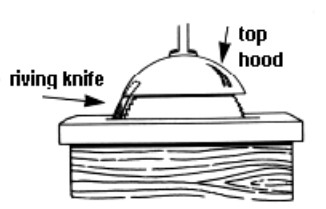
- The saw blade should be guarded above the bench by using an easily adjustable hood (top guard) and a correctly adjusted riving knife (back guard).
- The hood should be designed to cover the saw blade and riving knife down to the bench top and be used as low as practical while allowing timber and flitches to pass unobstructed.
- The hood must be securely mounted and be independent of the riving knife and be no more than 100mm wide (AS1473.1 (5.6.1))
- The lower half of the saw blade should be guarded to prevent inadvertent contact from below.
- No saw should be left unattended while rotating, either while it is powered or running down, unless the saw is completely enclosed.
- Where a saw brake is not fitted, and the saw is accessible, the saw must have a hood guard that is lowered to the bench height immediately when the saw is shut down.
- A riving knife should be manufactured from high grade steel and have a smooth finish.
- The inner edge of the riving knife should have a curved shape to suit the largest saw blade used in the bench and be adjustable in both the vertical and horizontal directions.
- Saw blade drives, pulleys and other nip points should be guarded.
- Power feed benches should be guarded, or an emergency stop bar fitted, to prevent the operator from being dragged into the saw.
- The in-feed drive hob should be guarded to protect workers fingers from being crushed and pulled into the feed. Where possible consideration should be given to installing an emergency hob release mechanism.
- Emergency stop devices must be placed within easy reach of the operator/benchman and the tail-out worker.
- Materials may be thrown from the saw - this can occur as a result of kickback or as part of the normal milling processes. The risk of injury from “kickback” can be controlled through the combination of:
- guarding the saw blade and the use of correctly adjusted riving knives/back guards and hoods/top guards. Anti-kickback devices can also be fitted.
- Access for maintenance, cleaning or removing blockages etc. must not be permitted unless the equipment is isolated from all sources of energy and tagged/locked out.
- Australian Standard 1473.1-2000 provides further information on the design, manufacture, guarding and use of milling equipment used for the primary milling of saw logs into green sawn timber products
A safe system of work for using bench saws or similar should be implemented and maintained. This could include:
- ensuring the bench saw is inspected, maintained, and repaired according to the manufacturer’s recommendations and specifications (the manufacturer's maintenance instructions must be included in a safe work procedure on how inspection and maintenance should be carried out). Visually inspect the saw for damage before use
- inspection and maintenance of the blade prior to use - this is important as poor blade condition can result in extra effort/ exertion in pushing and controlling the cutting direction
- providing information, training, instruction, and supervision to workers who will use the bench saw that includes the development of safe work procedures in accordance with the manufacturer’s operating instructions. Training and instructions should include the safety warnings (sometimes referred to as the Do’s and Don’ts) that are in the manufacturer’s instructions
- ensuring practical and hands-on training is given to workers, taking into account literacy levels, work experience and the specific skills required for safe use of the equipment. This includes safe work procedures with instructions on:
- the correct use of guarding and other control measures (such as work piece clamps and supports)
- how to safely operate and maintain the plant or equipment (including appropriate material selection criteria suitable for use in the saw, e.g. timber with nails, plastic etc)
- information on setting up the equipment and the work area to minimise any risks from working in awkward positions
- cleaning processes according to the manufacturer’s instructions.
- consulting with workers to obtain feedback on the bench saw, and associated work processes and safe work procedures.
Any remaining risk must be further minimised with suitable personal protective equipment. For example, hard hats, protective footwear, eye protection and hearing protection.
Administrative control measures and PPE rely on human behaviour and supervision. If used on their own, they are least effective in minimising risks. The control measures you put in place should be reviewed regularly to make sure they work as planned.
More Information
- How to manage work health and safety risks Code of Practice 2021 (PDF, 0.6 MB)
- Sawmilling industry Health and safety guide 2017 (PDF, 2 MB)
- Guide to machinery and equipment safety (PDF, 1.46 MB)
- Manufacturing fixed plant - self assessment tool (PDF, 1.49 MB)
- Machine guarding (film)
- Isolating machinery when not in production (film)
- AS 4024 Safety of Machinery (series)
If this information has caused distress, there are services to help:
- Lifeline – 24/7 crisis support service, including phone, texting and chat services.
- Beyond Blue – information and support for anxiety, depression and suicide prevention for everyone in Australia.
- Black Dog Institute – research and resources on mental health in the workplace.
- SANE – helpline service, as well as resources on mental health.
Have you been affected by a workplace fatality, illness or serious injury?
For advice and support, visit our Facebook page or email ohs.coronialliaison@oir.qld.gov.au.