
Worker sustains crush injuries from falling pipe
MAY CONTAIN DISTRESSING CONTENT TO SOME READERS
In mid 2025, a worker sustained two fractured legs after being struck by a large plastic pipe. It appears the worker was working on a pipe production line when they were struck by a large plastic pipe- approximately 43 metres in length - fell off a table while it was being moved into position with a forklift.
These findings are not yet confirmed, and investigations are continuing into the exact cause.
Safety issues
Forklifts are a practical way to move and stack goods and materials. However, they are also one of the most hazardous workplace vehicles. Forklifts are frequently found in warehouses, workshops, and factories. People working with or around them often become complacent because the vehicles can be quiet, used frequently, and are often part of a busy work environment.
Forklift operators and pedestrians are at risk of serious crush injuries caused by falling loads and the forklift itself. Even at low speeds, forklifts can leave people with serious injuries or worse. Pedestrians are at risk as well as the person using the forklift.
Examples of risks when using forklifts are:
- Collisions - both with people, other plant, and structures. Colliding with a structure can pose an immediate risk to the operator but also create instability in the structure leading to further risk to people close by.
- Instability - tipping over can happen quite easily (for example, when carrying an uneven load, or braking or accelerating down a slope).
- Speed and stopping distances - applying a forklift’s brakes inappropriately can cause the forklift to tip forward or lose its load.
- Falling objects - incorrectly supported loads can tip and fall from the forklift tines (e.g. non-palletised and unstrapped loads). In some cases, the load will be too large and of the wrong shape to be lifted using forklift tines.
- Crushing – where a worker is crushed between a stationary object (e.g. truck being unloaded or structure) and a forklift.
Ways to manage health and safety
Effective risk management starts with a commitment to health and safety from those who manage the business. If an incident occurs, you will need to show the regulator that you have used an effective risk management process. This responsibility is covered by your primary duty of care in the Work Health and Safety Act 2011.
Use the hierarchy of controls to help decide how to eliminate and reduce risks in your place of work. The hierarchy of controls ranks types of control methods from the highest level of protection and reliability to the lowest. It is a step-by-step approach to eliminating or reducing risks. You must work through the hierarchy of controls when managing risks, with the aim of eliminating the hazard, which is the most effective control.
Further information about the hierarchy of controls and managing risks can be found on the WorkSafe.qld.gov.au website: Managing risks.
Possible control measures to prevent similar incidents
A person conducting a business or undertaking (PCBU) has a duty to ensure workers and others are not exposed to health and safety risks, including the risks associated with powered mobile plant such as forklifts and traffic hazards in the workplace. The PCBU must ensure that the mobile plant (forklift) selected is the right selection for the task or if there is a safer alternative (plant or process) to complete the task.
The most effective control measure is to eliminate the hazard or hazardous work practice associated with forklift and pedestrian interactions. Where elimination cannot be achieved, other controls can be implemented to minimise the risk.
The risk of forklift-related injuries can also be reduced by making sure workers are well trained, machinery is well maintained, and a traffic management plan (inclusive of implementing and maintaining exclusion zones), is in place.
It is important to operate a forklift safely and create a safe work environment to minimise the risk of incidents. Simple measures that can make a big difference, are:
- Not using forklifts to lift and move loads that are inherently unstable or could roll off the forklift tines.
- Pipes and other round loads should be lifted by purpose designed plant or by a crane where the load is suspended with lifting slings that have been selected and positioned by a worker with the appropriate High Risk Work License (i.e. minimum Dogging HRWL). In some situations, smaller pipes could be lifted by a lifting jib attachment on a forklift, provided the jib has been certified for use on that forklift.
- Using proximity devices to warn and control pedestrian and plant interactions.
- Separating pedestrians from forklifts such as overhead walkways and physical barriers.
- Observing speed limits and stop signs.
- Wearing correctly fitted seat belts.
- Slowing down and sounding the horn at intersections.
- Ensuring the forklift operator has a clear view in the direction of travel.
- Using of a spotter directing forklift movement and pedestrian interaction.
Traffic management plan
Whenever mobile plant such as a forklift is used in a workplace, a traffic management plan must be implemented to ensure the safety of drivers and pedestrians. It should be developed by those in charge of the business in consultation with workers and others in the workplace. Everyone affected by the plan must understand it and follow it.
The plan should consider:
- The physical environment, such as lighting, road surfaces, ventilation, and weather.
- Traffic destination, flow, volume, and priorities.
- Forklift stopping distances, turning (tail swing), and operator blind spots.
- Forklift characteristics, such as stability and attachments.
- Load characteristics, such as height, width and type - reorganising the layout of the workplace to minimise areas shared by pedestrians and forklifts.
- Ensuring workers are not placed at risk by walking with a load on the forklift to stabilise the load.
- Excluding workers from areas where vehicles are loaded and unloaded.
- Blind spots and corners as well as blind corners that have been identified as high risk include:
- on entry to warehouse doors and entry to rear factory from both access points. Also, most types of mobile plant have blind spots where the operator cannot see certain angles due to obstructions by the plant (mirrors, mast, frames, stacking of dunnage), or difficulty for the driver to twist in position to see in all reversing directions.
See Figure 1.
- on entry to warehouse doors and entry to rear factory from both access points. Also, most types of mobile plant have blind spots where the operator cannot see certain angles due to obstructions by the plant (mirrors, mast, frames, stacking of dunnage), or difficulty for the driver to twist in position to see in all reversing directions.
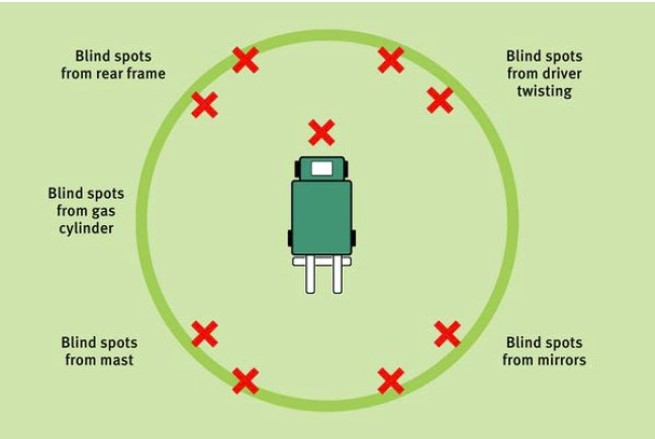
Figure 1: Forklift blind spots
- Installation of convex mirrors in some locations to allow a worker to see around blind corners – everyone should be aware of their location and use them when approaching the corner.
- Using physical barriers such as safety barriers, containment fences, bollards, or railed walkways where possible. See Figure 2.
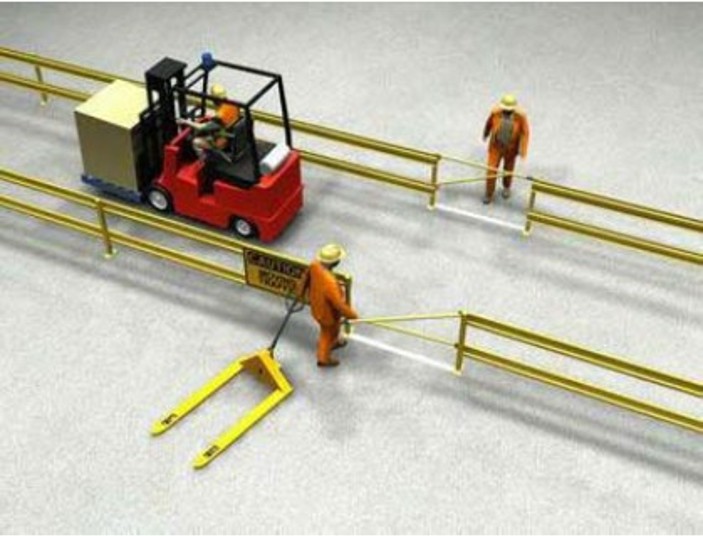
Figure 2: Barriers to separate pedestrians and mobile plant
- A combination of audio (e.g., reversing alarms and horns) and visual (e.g., flashing lights) warning devices.
- Signs to indicate who must give way.
- Implementing and enforcing procedures that describe how pedestrians and forklifts must interact in different situations.
The traffic management plan should also ensure:
- It is clear to forklift operators and workers who has right of way.
- Any no-go zones for forklifts or pedestrians are clearly isolated and marked.
- If high visibility vests are required, they are readily available to staff and visitors.
- Pedestrian floor markings are highly visible and not faded.
- Speed limits are clearly signed and followed. The speed limit applies to all forklifts, trucks, cars and other mobile plant, without exception.
- Traffic directions, such as 'stop' and 'one way', are clearly signed and followed.
- Proximity devices are operating efficiently to trigger signals, boom gates, and warning signs to give advanced warning to pedestrians and operators.
- That pedestrians and forklift operators are wearing high-visibility or reflective clothing, (although this is no substitute for physically separating pedestrians and forklifts).
Further information and advice on traffic management can be found at: Traffic management guidance plan and example template (PDF, 2.01 MB).
Be well prepared and properly trained
- Only operate a forklift if you hold a high-risk work licence or are an authorised trainee.
- Do not operate a forklift when you are tired.
- Do what is reasonably practicable to be safe, such as wearing a seatbelt if one is provided. The only exception is if a risk assessment advises otherwise.
- Use the forklift only for the purpose for which it was designed.
- Read and follow the manufacturer’s specifications.
- Before driving a forklift onto a truck, trailer, or rail wagon, check the brakes of the receiving vehicle are set, and the wheels are chocked.
Take care when loading a forklift
- Make sure loads are within the rated load capacity of the forklift.
- Carry loads as close to the ground as possible.
- Place loads fully against the truck carriage or back rest. The mast should be tilted sufficiently backward to safeguard the load.
Drive safely
- Keep a clear view ahead and behind, using a correctly adjusted rear-view mirror.
- Clearly indicate your intentions.
- Keep a safe distance from other vehicles.
- Do not speed up or slow down quickly.
- Slow down when turning.
- Drive in reverse if you cannot see past a bulky load.
- If you are driving up an incline with a load:
- make sure the load faces forward
- tilt the mast back sufficiently to safeguard the load
- raise the forks so they clear the ground.
- If driving down an incline with a load:
- drive in reverse with the load and forks facing up the incline
- tilt the mast back sufficiently to safeguard the load
- raise the forks so they clear the ground.
- If you are driving up an incline with no load, place the forks on the downhill side of the forklift.
- Remove the starter-switch key when you leave the forklift. Make sure the:
- controls are in neutral
- power is shut off
- park brakes are applied
- forks are fully lowered.
Be aware of your work environment
- Drive carefully on wet or slippery surfaces and when pedestrians are nearby.
- Make sure the tip of the fork, or load, or the rear side of the forklift, does not touch a person or object.
- Never park or leave the forklift in any doorway, entrance, or emergency exit, or in front of fire-extinguishing equipment.
- Check for overhead obstructions (such as powerlines), loading docks, and other mobile plant.
More Information
- Dangers in your workplace - Forklifts
- Managing the risks of plant in the workplace Code of Practice 2021 (PDF, 2.77 MB)
- Managing the risk of falls at workplaces Code of Practice 2021 (PDF, 3.9 MB)
- How to manage work health and safety risks Code of Practice 2021 (PDF, 0.6 MB)
- Managing traffic onsite - video
- Forklift safety - reducing the risks guide (PDF, 0.27 MB)
- Traffic management guidance plan and example template (PDF, 2.01 MB)
If this information has caused distress, there are services to help:
- Lifeline – 24/7 crisis support service, including phone, texting and chat services.
- Beyond Blue – information and support for anxiety, depression and suicide prevention for everyone in Australia.
- Black Dog Institute – research and resources on mental health in the workplace.
- SANE – helpline service, as well as resources on mental health.
Have you been affected by a workplace fatality, illness or serious injury?
For advice and support: