
Transport and warehousing campaign report (February–March 2026)
Workplace Health and Safety Queensland (WHSQ) conducted a transport and warehousing industry compliance campaign between February and March 2026, focusing on the use of plant. The campaign aimed to reduce fatalities and serious injuries by increasing industry awareness and assessing work health and safety compliance at transport and warehousing businesses throughout Queensland.
From 2023 to 2024, there were 3114 worker compensation claims with 2420 claims relating to machinery and fixed plant. In 2024, the industry accounted for 32.1% of workplace fatalities in Queensland, and serious incidents continue to occur.
The campaign included two phases: phase one – education and awareness; phase two – inspector activities, including workplace inspections and compliance action.
Phase one - How we shared safety knowledge
Phase one of the campaign focused on education and awareness. We reached approximately 80,000 Queensland businesses by email, sharing targeted information and practical guidance materials.
During site visits, inspectors asked workplace representatives to complete a survey about campaign communications and whether it had led to any safety changes at their workplace. The following insights are based on responses from 56 workplace representatives:
- Approximately a third of the respondents surveyed were aware of the campaign.
- The most common source of campaign awareness was the notification email.
- Nearly two-thirds of respondents conducted a workplace inspection after becoming aware of the campaign.
Phase two - What we found
Phase two focused on workplace inspections. Inspectors assessed compliance and addressed non-compliance. Between February and March 2026, inspectors completed 641 assessments of transport and warehousing businesses across Queensland.
To ensure a fair and consistent approach, all assessments were conducted using a standardised audit tool.
Inspectors identified the following common areas of non-compliance:
Plant
- Plant guarding was missing, removed or inadequate.
- Control levers and emergency stop controls were not clearly labelled.
- Inspections by a competent person had not been completed.
- Dangerous nip, entrapment and moving parts were accessible to workers.
- Access to operating plant was unsafe, including unattended equipment and access to unguarded rotating components.
Electrical
- Switchboards were obstructed, limiting safe access.
- Electrical equipment testing and tagging requirements were not met.
- Safety switches were not regularly tested.
- Switchboard panels were unsecured, exposing workers to live electrical parts.
Pallet racking
- Safe working load limits were not displayed.
- Pallet racking was not adequately secured to walls or floors.
- Impact protection was missing or inadequate.
- Inspections by a competent person had not been completed.
- Risks from falling objects were not adequately controlled.
Hazardous chemicals
- Spill containment measures were not implemented.
- Hazardous chemicals and storage systems were not adequately labelled.
- Hazardous chemical registers, manifests and safety data sheets were missing, incomplete or not readily accessible.
- Safety showers and eyewash facilities were not provided where required.
- Chemical storage controls, including impact protection and gas cylinder restraint, were inadequate.
Other hazards
- Workplace facilities and emergency washing facilities were inadequate.
- Traffic management plans, including separation of pedestrians and mobile plant, were inadequate.
- Emergency preparedness issues were identified, including missing or inadequate emergency plans and fire protection equipment.
- Consultation requirements relating to health and safety representatives were not being met.
- Respiratory and hearing protection controls were not adequately implemented or maintained.
What actions we took
Inspectors issued 751 enforcement notices during the campaign.
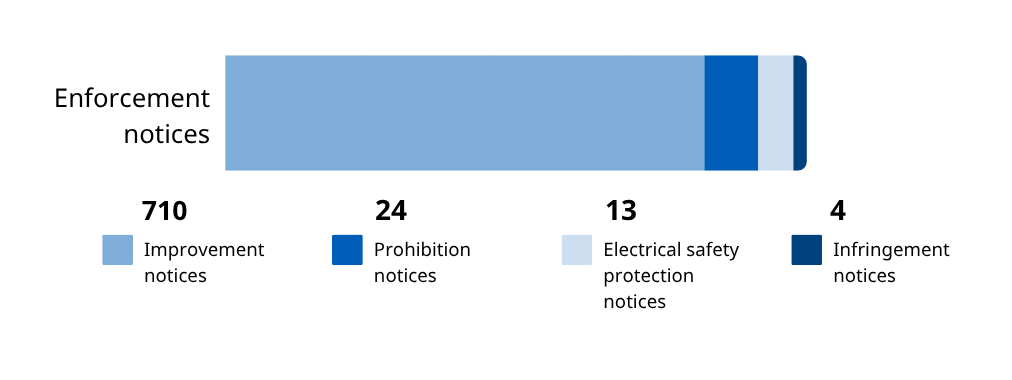
A further 172 non-compliances were rectified while inspectors were on site. Inspectors also issued four infringements notices.
The table below provides details of the top three most common infringement notices issued.
Section 50(1) Work Health and Safety Regulation 2011 | A person conducting a business or undertaking (PCBU) must ensure that air monitoring is carried out if it is unsure whether workers are being exposed to a substance in the air above the legal exposure limit, or if air monitoring is needed to check whether the substance could be affecting workers’ health. |
Section 68(1) Electrical Safety Regulation 2013 | A PCBU must ensure, so far as is reasonably practicable, that no person, plant or thing at the workplace comes within an unsafe distance of an overhead or underground electric line. |
Section 346(1) Work Health and Safety Regulation 2011 | A PCBU must keep a register of all hazardous chemicals that are used, handled or stored at the workplace. The register must be kept at the workplace and updated whenever there are changes to ensure the information remains up to date. |
How to keep your workplace safe
To effectively manage risks from mobile plant in transport and warehousing workplaces, it is recommended that businesses take the following actions:
- Ensure plant, machinery and storage systems are regularly inspected, maintained and used in accordance with manufacturer specifications.
- Install and maintain effective guarding, barriers and impact protection to prevent contact with moving parts and protect infrastructure from vehicle impacts.
- Ensure pallet racking is structurally sound, adequately secured, inspected by a competent person and displays safe working load limits.
- Identify, assess and control risks associated with hazardous chemicals, including appropriate storage, labelling, signage and access to safety data sheets.
- Maintain electrical installations and equipment in a safe condition, including ensuring switchboards remain accessible and required testing is completed.
- Implement safe systems of work for forklifts and other mobile plant, including pre-start inspections, maintenance and traffic management arrangements.
- Provide clear emergency procedures, appropriate emergency equipment and adequate workplace facilities for workers.
- Consult with workers on health and safety matters, and provide suitable information, training, instruction and supervision.
- Ensure personal protective equipment is fit for purpose, maintained and used where required.
- Regularly review risk controls to ensure they remain effective and address changes in workplace activities.
Safety is a shared responsibility. Whether you’re an employer, contractor, worker, or dedicated health and safety representative—you play a role in keeping yourself and others safe.