
Mobile amusement campaign report (January–September 2025)
Workplace Health and Safety Queensland (WHSQ) conducted a mobile amusement device industry compliance campaign between January and September 2025. The campaign focused on preventing serious injuries by increasing industry awareness and assessing work health and safety compliance at temporary shows and events across Queensland.
The WHSQ Priority Plan 2024-2030 notes operating amusement devices may generate rare, but serious risks to workers and public health and safety.
The campaign included two phases: phase one – education and awareness; phase two – inspector activities, including workplace inspections and compliance action.
Phase one - How we shared safety knowledge
Phase one of the campaign focused on education and awareness. We reached 95 businesses by email, sharing targeted information and practical guidance materials.
Phase two - What we found
Phase two focused on workplace inspections. Inspectors assessed compliance and addressed non-compliance. Between January and September 2025, inspectors conducted 384 cases focused on mobile amusement devices across Queensland.
To ensure a fair and consistent approach, inspectors used one of the three standardised audit tools to audit mobile amusement devices.
The audit tools are:
- National Audit Tool for Amusement Devices – Full audit (PDF, 0.61 MB)
- National Audit Tool for Amusement Devices – Site set up audit
- WHSQ inflatable amusement assessment.
Inspectors identified the following common areas of non-compliance:
Plant
- Mobile amusement devices were poorly maintained, including:
- rider restraints were damaged
- rails on rider carriages were missing
- exit gate interlocks were broken.
- Plant operating controls were poorly maintained or worn, making them difficult to read.
- Passenger accessways were poorly maintained, creating slip, trip and fall hazards.
- Mobile amusement devices were erected without suitable controls to prevent falls, including:
- inadequate training
- unchecked fall harnesses
- unsuitable anchor points.
- Mobile amusement devices were set up unsafely, including:
- use of unsuitable dunnage
- ride secured with metal stakes near underground electric lines.
Electrical installations
- Required electrical equipment safety checks (e.g. testing and tagging) were either missing or out of date.
- There was access to live electrical components in electrical switchboards (e.g. missing pole fillers, holes, and unsecured escutcheon panels).
- Electrical installations and/or equipment were unsafe including the use of double adapters and piggybacking of electrical leads.
- Electrical equipment was damaged, including electrical leads, deteriorated electrical insulation, damaged electrical conduit.
Other
- Hazardous chemical storage was non-compliant.
- Asbestos was not adequately managed (e.g. no asbestos management plan).
- Towing practices were unsafe (e.g. using chains for which the safe working load is unknown).
- Mobile plant was operated without a high-risk work licence (e.g. forklift operation).
What actions we took
Inspectors issued 34 notices during the campaign. Businesses also fixed a further 137 issues while inspectors were on site.
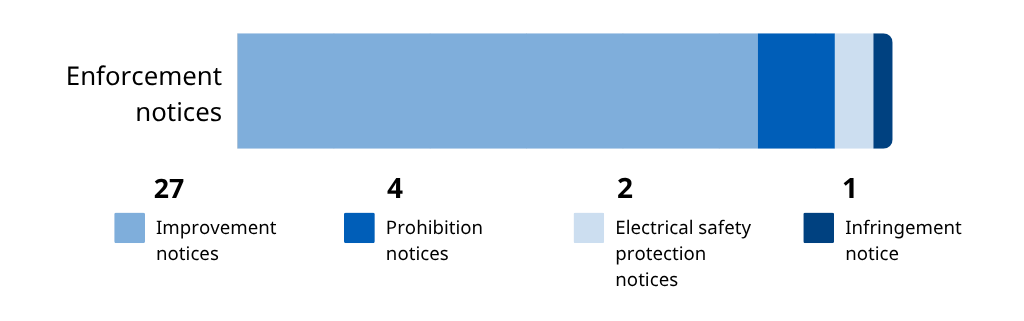
One infringement was issued, with a penalty of $2160 relating to section 85(1) of the Work Health and Safety Regulation 2011. The business was fined for allowing a worker to do high-risk work without seeing written evidence of their high-risk work licence.
How to keep your workplace safe
To effectively manage risks from mobile amusement devices at shows and events, owners and operators should do the following:
- Regularly inspect and maintain devices according to the manufacturer's specifications. Keep any maintenance records in the device logbook.
- Identify fall-from-height risks during the setup and dismantling of the device and implement suitable control measures.
- Assess the device setup area for potential hazards and confirm the location is safe (e.g. avoiding underground services).
- Inspect and maintain all electrical equipment and installations.
- Ensure workers hold the required high-risk work licences.
- Use transport equipment that is suitable, fit for purpose, and correctly rated.
Safety is a shared responsibility. Whether you’re an employer, contractor, worker, or a health and safety representative—you play an important role in keeping yourself and others safe.