
Manufacturing campaign report (April–June 2026)
Workplace Health and Safety Queensland (WHSQ) conducted a manufacturing industry compliance campaign between April and June 2026, focusing on the priority hazard area of mobile plant. The campaign aimed to reduce fatalities and serious injuries by raising industry awareness and assessing work health and safety compliance at manufacturing businesses across Queensland.
Between 2019 and 2023, there were 17 worker fatalities in the manufacturing industry nationally, with approximately 12% involving mobile plant. Incidents involving mobile plant continue to seriously injure workers.
In Queensland, 24,524 workers' compensation claims were lodged by workers in the manufacturing industry between 2022 and 2024, with 47.2% of these claims related to mobile plant.
The campaign included two phases: phase one – education and awareness; phase two – inspector activities, including workplace inspections and compliance action.
Phase one - How we shared safety knowledge
Phase one of the campaign focused on education and awareness. We reached approximately 52,526 Queensland businesses by email, sharing targeted information and practical guidance materials.
Following the campaign, WHSQ surveyed businesses to understand its effectiveness, impact and long-term value. The following insights are based on 25 survey responses:
- 60% of all survey respondents reviewed and updated safety management systems.
- 30% of surveyed respondents reported that they communicated with senior leaders about the campaign or reviewed hazard controls.
- Some businesses also discussed the campaign with workers, reviewed hazard controls and conducted workplace inspections.
- As a result of the campaign, businesses reported implementing improvements such as traffic management measures and annual pallet racking inspections.
Phase two - What we found
Phase two focused on workplace inspections. Inspectors assessed compliance and addressed non-compliance. Between April and June 2026, inspectors completed 494 assessments of manufacturing businesses across Queensland.
To ensure a fair and consistent approach, all assessments were conducted using a standardised audit tool.
Inspectors identified the following common areas of non-compliance:
Mobile plant and traffic management
- Forklifts were poorly maintained and pre-start checks were not completed.
- Inspectors frequently identified damaged safety features such as seatbelts, lights and alarms.
- Businesses had not adequately separated workers from forklift operating areas.
Plant maintenance
- Plant and equipment were not regularly inspected or serviced.
- Businesses often failed to maintain maintenance records.
- Defects remained unaddressed, increasing safety risks.
Training and consultation
- Businesses did not always verify worker licences and competency.
- Businesses often provided inadequate training on forklifts and site-specific risks.
- Workers were not informed about health and safety representative (HSR) rights and representation.
Hazardous chemicals
- Chemical registers and safety data sheets were missing or out of date.
- Chemicals were not correctly labelled.
- Spill response and chemical signage were often inadequate.
Electrical safety
- Electrical equipment and safety switches were overdue for testing.
- Damaged switchboards and electrical defects were identified.
- Businesses often had no records of electrical inspections.
What actions we took
Inspectors issued 782 enforcement notices during the campaign.
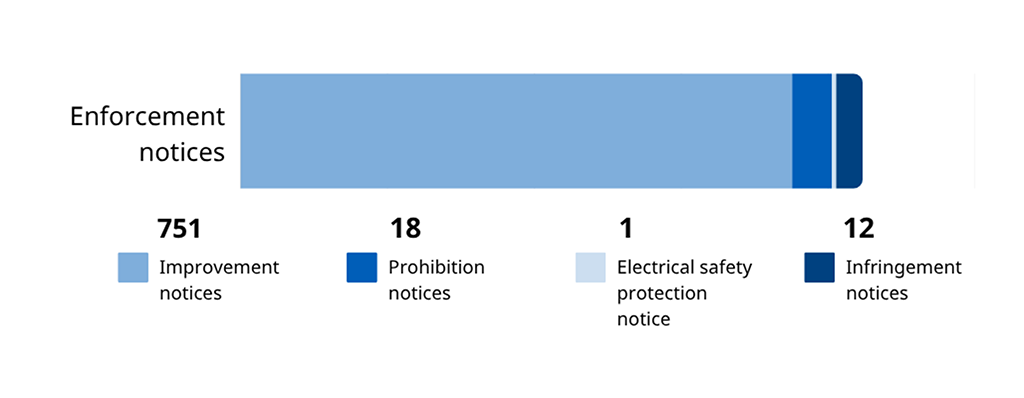
A further 166 non-compliances were rectified while inspectors were on site. Inspectors issued 12 infringement notices, with the most common issue being workers undertaking high-risk work without the required high-risk work licence.
How to keep your workplace safe
To effectively manage risks from mobile plant in manufacturing workplaces, it is recommended that businesses take the following actions:
- Maintain and service all mobile plant and promptly address issues such as broken seatbelts and damaged seats.
- Secure unattended plant, remove keys and prevent unauthorised use.
- Complete pre‑operational checks, inspect plant before use and keep records of completed checks.
- Isolate damaged or faulty plant and tag plant out of service until repairs are completed.
- Provide information about forklift attachments and ensure workers understand how attachments can affect forklift capacity.
- Verify licences and records, ensure plant operators hold the required high-risk work licences and maintain appropriate records.
- Implement effective traffic management controls and manage interactions between mobile plant, vehicles and pedestrians.
- Create safe areas for workers and visitors, establish safe areas for delivery drivers and provide clearly marked pedestrian walkways.
- Educate workers and verify competency, provide plant-specific training and regularly assess worker competency.
- Maintain electrical safety, verify electrical installations and equipment and comply with electrical testing requirements.
Safety is a shared responsibility. Whether you’re an employer, contractor, worker, or health and safety representative—you play a role in keeping yourself and others safe.