
Manufacturing campaign report (April–June 2025)
Workplace Health and Safety Queensland (WHSQ) conducted a manufacturing industry compliance campaign between April and June 2025, focusing on the priority hazard area of fixed plant. This campaign aimed to reduce fatalities and serious injuries by increasing industry awareness and assessing work health and safety compliance at manufacturing businesses throughout Queensland.
From 2020 to 2024, machinery and fixed plant accounted for 56.3% of fatalities in Queensland’s manufacturing industry and workers continue to experience serious injuries.
The campaign included two phases: phase one – education and awareness; phase two – inspector activities, including workplace inspections and compliance action.
Phase one - How we shared safety knowledge
Phase one of the campaign focused on education and awareness. We reached approximately 36,000 Queensland businesses by email, sharing targeted information and practical guidance materials.
More than 66% of recipients (almost 24,000 businesses) engaged with the email. Following the campaign, we surveyed businesses to understand its effectiveness, impact and long-term value. The below insights are based on 268 survey responses:
- 81% of respondents from the manufacturing industry felt prepared for the audit.
- Nearly half of all survey respondents took action as a result of the email. They communicated with senior leaders, talked with workers, or reviewed hazard controls.
- Some businesses also conducted inspections of the workplace, held toolbox talks with workers and conducted risk assessments.
- The key driver of making long term work health and safety (WHS) changes was to remain compliant and improve safety, followed by a culture of continuous improvement.
- The key barrier to making long term WHS improvements was a lack of senior leadership commitment.
Phase two - What we found
Phase two focused on workplace inspections. Inspectors assessed compliance and responded to non-compliance. Between April and June 2025, inspectors conducted 217 assessments of manufacturing businesses across Queensland.
To ensure a fair and consistent approach, all assessments were conducted using a standardised audit tool.
Inspectors identified the following common areas of non-compliance:
Fixed plant
- Engineering controls were not maintained, inspected or used as required by the manufacturer, including:
- emergency stops were not clearly marked and easy to access
- emergency stop handles, bars or push buttons were not coloured red
- interlocks were bypassed, allowing access to moving parts while the plant was operating.
- Fixed plant was not secured to stop it moving during use or if hit by other equipment (e.g. mobile plant).
- Fixed plant on work benches was not secured, creating a risk of it falling onto workers operating the plant or onto the ground.
- Plant guarding was missing, not fitted properly, or damaged, and the plant was still being used.
- Fixed plant was not serviced or maintained as required by the manufacturer.
Electrical
- Energised equipment used with exposed conductors.
- Machinery connected using piggyback plugs and/or double adaptors.
- Electrical equipment was not tested by a competent person within the required intervals (i.e. tested and tagged).
- Machinery safety switches were not tested by a competent person within the required intervals.
- Electrical equipment and leads connected in such a way that:
- they became a trip hazard to workers
- equipment and leads were at risk of damage from moving parts or site traffic.
Information, training and instruction
- Workers were not given the information, training or instructions they needed.
- Work instructions were not followed by workers.
- Workers did tasks without clear procedures.
- No process to check workers were competent to use high-risk machinery (such as machines with rotating parts).
Work environment
- No exclusion zones to separate workers from hazards.
- No safe access to work areas.
- Poor storage of materials, limiting access and creating trip hazards.
- Poor layout and workflow planning, exposing untrained workers to rotating equipment.
Hazardous chemicals
- Incorrect or unlabelled hazardous chemical containers.
- Hazardous chemical registers either not developed or maintained.
- Safety Data Sheets (SDS) not current and/or readily available to workers.
What actions we took
Inspectors issued 413 enforcement notices as part of the campaign.
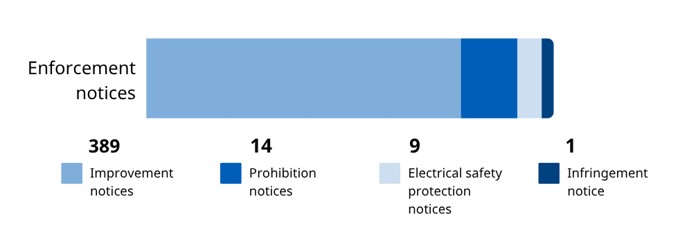
In addition to the 413 enforcement notices, a further 40 non-compliances were rectified while inspectors were on site.
Inspectors recorded non-compliances in 65% of the 217 assessments completed. ‘Non-compliance’ refers to the sum of both enforcement notices issued, and non-compliances rectified while inspectors were on site.
One infringement was issued, with a penalty totalling $3600 relating to section 346(1) of the Work Health and Safety Regulation 2011(hazardous chemicals register).
How to keep your workplace safe
To effectively manage risks from fixed plant in manufacturing workplaces, it is recommended that businesses take the following actions:
- Install and maintain guarding correctly; repair or replace damaged guarding before use.
- Secure all fixed plant and bench‑mounted equipment to prevent movement or toppling.
- Establish and maintain appropriate exclusion zones around hazardous plant.
- Follow servicing and maintenance schedules consistently.
- Provide workers with clear information, training, and task‑specific instructions.
- Verify, record, and maintain worker competency, especially for high‑risk machinery.
- Test and maintain electrical equipment at legislated intervals by a competent person.
- Improve storage practices to prevent obstructions and trip hazards.
- Correctly label all hazardous chemical containers.
Safety is a shared responsibility. Whether you’re an employer, contractor, worker, or a dedicated health and safety representative—you play a role in keeping yourself and others safe.