
Construction campaign report (March–June 2025)
Workplace Health and Safety Queensland (WHSQ) conducted a construction industry compliance campaign between March and June 2025, focusing on the priority hazard area of mobile plant, particularly onsite traffic management. The campaign aimed to reduce fatalities and serious injuries by increasing industry awareness and assessing work health and safety compliance at construction businesses throughout Queensland.
From 2020 to 2024, mobile plant and transport accounted for 48.7% of fatalities in Queensland’s construction industry and workers continue to experience serious incidents and fatalities involving mobile plant.
The campaign included two phases: phase one – education and awareness; phase two – inspector activities, including workplace inspections and compliance action.
Phase one - How we shared safety knowledge
Phase one of the campaign focused on education and awareness. We reached over 50,000 Queensland businesses by email, sharing targeted information and practical guidance materials.
Following the campaign, we surveyed businesses to understand its effectiveness, impact and long-term value. The below insights are based on 1211 survey responses:
- 61% of respondents felt prepared for the audit.
- More than half of the respondents took action after receiving the email, including discussing safety matters with workers and holding toolbox talks.
- Some businesses also:
- conducted workplace inspections
- reviewed safety controls
- discussed the campaign with senior leaders.
Phase two - What we found
Phase two focused on workplace inspections. Inspectors assessed compliance and addressed non-compliance. Between March and June 2025, inspectors conducted 393 assessments of construction sites across Queensland.
To ensure a fair and consistent approach, all assessments were conducted using a standardised audit tool.
Inspectors identified the following common areas of non-compliance:
Mobile plant
- Vehicles blocked public roads without suitable traffic controls.
- Workers did not use safety features on mobile plant as intended by the manufacturer.
- Movement warning devices fitted to mobile plant were not working or were not used.
- Workers did not isolate powered mobile plant when it was not in use.
Safe systems of work
- Traffic management plans were missing, out of date, or not followed.
- Workers were not aware of documented safety controls, including traffic management plans.
- Workers had not received adequate training to carry out their work safely.
- Safe work method statements (SWMS) for high-risk construction work had not been prepared.
- Arrangements to comply with SWMS had not been implemented.
- Work health and safety management plans were missing for construction projects.
Work environment
- Signs or barriers to separate workers from mobile plant were not installed.
- Construction sites were not secured to prevent unauthorised access.
- Vehicles and pedestrians shared the same site entry.
- Poor housekeeping made it difficult for workers to safely access work areas.
- Electrical equipment was not tested and tagged as required.
Work at heights
- Timber edge protection did not meet safety requirements.
- Scaffolding was missing key safety components, such as kickboards, mid-rails, or top rails.
- Workers commenced work at heights before the required safety controls were in place.
- Workers performed tasks near stair voids and other openings without suitable controls.
What actions we took
Inspectors issued 431 enforcement notices during the campaign.
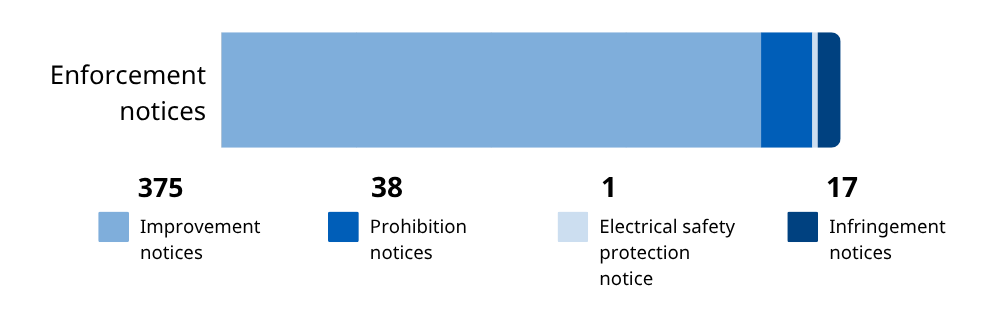
A further 292 non-compliances were rectified while inspectors were on site.
Inspectors also issued 17 infringement notices, with penalties totalling $54,840.
The table below provides details of the top three most common infringement notices issued.
Section 300(1) Work Health and Safety Regulation 2011. | Persons conducting a business or undertaking (PCBU) failed to put arrangements in place to ensure that high risk construction work is carried out in accordance with SWMS. |
Section 313(3) Work Health and Safety Regulation 2011. | PCBU failed to ensure that a copy of WHS management plan was readily accessible to a person carrying out construction work connected with project for prescribed period. |
Section 300(2) Work Health and Safety Regulation 2011. | PCBU failed to ensure that high risk construction work not being carried out in accordance with the SWMS was stopped immediately, or as soon as it was safe to do so and only resumed once the work was being done in accordance with the SWMS. |
How to keep your workplace safe
To effectively manage risks associated with mobile plant on construction sites, it is recommended that businesses take the following actions:
- Implement effective traffic management plans. Ensure traffic management controls are documented, current and followed on site.
- Separate pedestrians from mobile plant. Use barriers, signage and designated walkways to reduce the risk of collisions.
- Maintain mobile plant in safe condition. Regularly inspect plant and ensure safety features and warning devices are working properly.
- Educate workers and verify competency. Ensure workers understand site safety controls and can safely operate mobile plant.
- Secure construction sites. Prevent unauthorised access by maintaining site security measures.
- Manage work at heights. Ensure edge protection, scaffolding and other height safety controls are in place before work begins.
Safety is a shared responsibility. Whether you’re an employer, contractor, worker, or a health and safety representative—you play an important role in keeping yourself and others safe.