
Construction campaign report (July–September 2025)
Workplace Health and Safety Queensland (WHSQ) conducted a construction industry compliance campaign between July and September 2025, focusing on use of plant, especially powered and non-powered tools and equipment. The campaign aimed to reduce fatalities and serious injuries by increasing industry awareness and assessing work health and safety compliance at construction businesses throughout Queensland.
In the Queensland construction industry from 2019 to 2023, there were 5643 worker compensation claims relating to powered and non-powered tools, appliances and equipment.
The campaign included two phases: phase one – education and awareness; phase two – inspector activities, including workplace inspections and compliance action.
Phase one - How we shared safety knowledge
Phase one of the campaign focused on education and awareness. We reached over 66,000 Queensland businesses by email, sharing targeted information and practical guidance materials.
During site visits, inspectors asked workplace representatives to complete a survey about campaign communications and whether it had led to any safety changes at their workplace. The following insights are based on 187 survey responses:
- Approximately half of the respondents surveyed were aware of the campaign.
- The most common source of awareness of the campaign was the notification email.
- The vast majority of persons conducting a business or undertaking (PCBUs)—over 9 in 10—took some form of action as a result of finding out about the campaign. This included both undertaking routine safety measures and taking additional safety measures beyond the routine measures.
Phase two - What we found
Phase two focused on workplace inspections. Inspectors assessed compliance and addressed non-compliance. Between July and September 2025, inspectors conducted 666 inspections of construction sites across Queensland.
To ensure a fair and consistent approach, all assessments were conducted using a standardised audit tool.
Inspectors identified the following common areas of non-compliance:
Use of tools and equipment
- Equipment with missing or damaged guards, including grinders, cement mixers and drop saws.
- Inadequate management of risk of noise-induced hearing loss when operating plant.
- Electrical equipment not tested and tagged as required.
- Power tools used in unsafe positions and locations (e.g. while standing on the top rung of a ladder).
- Poor ventilation and respiratory protection during hot work activities (e.g. while oxyacetylene welding).
Ladders, trestles and falls from height
- Unsafe ladder use, including damaged ladders, unsecured ladders and standing on the top rung.
- Unsafe trestle set-ups, including missing handrails and unsecured planks.
- Scaffolds with missing components that increased fall risks.
- Safe work method statements (SWMS) for work at heights were missing or not followed.
- Incorrect use of travel restraint systems (harness not attached, incorrectly implemented).
Respirable crystalline silica dust (silica dust)
- Dust controls were not used during silica-generating tasks.
- H-class and M-class vacuums were poorly maintained with damaged or missing attachments.
- Respiratory protective equipment was used incorrectly.
- Workers were not fit tested or had out-of-date fit testing.
- Workers had facial hair that prevented the seal of tight-fitting respirators.
- Silica dust allowed to build up in work areas.
- Safe work procedures did not adequately manage silica dust risks.
Other hazards
- Poor maintenance of mobile plant, including:
- broken warning devices
- missing pre-operational checks.
- Accessways blocked by stored materials or waste.
- Construction sites did not have a workplace health and safety management plan (WHSMP).
What actions we took
Inspectors issued 890 enforcement notices during the campaign.
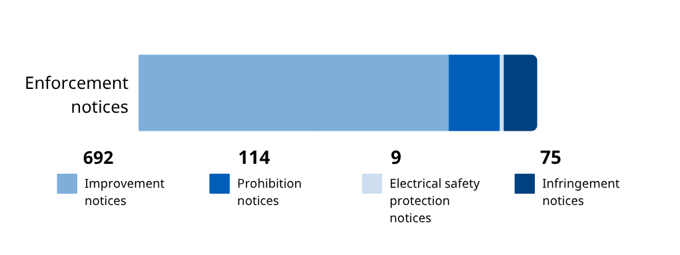
Businesses also fixed a further 561 issues while inspectors were on site.
Inspectors also issued 75 infringement notices.
The table below provides details of the top three most common infringement notices issued.
Section 300(1) Work Health and Safety Regulation 2011. | PCBUs failed to put in place arrangements for ensuring that high risk construction work is carried out in accordance with safe work method statement (SWMS). |
Section 300(2) Work Health and Safety Regulation 2011. | PCBUs failed to ensure that high risk construction work not being carried out in accordance with the SWMS was stopped immediately, or as soon as it was safe to do so, and only resumed once the work was being done in accordance with the SWMS. |
Section 315F(3) Work Health and Safety Regulation 2011. | The principal contractor for a construction project failed to ensure that site hoarding meets legislative requirements. |
How to keep your workplace safe
To effectively manage risks associated with use of plant on construction sites, it is recommended that businesses take the following actions:
- Inspect and maintain handheld tools to ensure they are in good working condition.
- Ensure ladders and trestles are set up correctly, with secure components and safe access.
- Maintain on-tool dust extraction equipment used to minimise silica dust exposure.
- Minimise workers’ noise exposure by controlling noise at the source and providing appropriate hearing protection.
- Keep worksites tidy by removing waste and clearing accessways.
Safety is a shared responsibility. Whether you’re an employer, contractor, worker, or a health and safety representative—you play an important role in keeping yourself and others safe.