
Construction campaign report (February–March 2026)
Workplace Health and Safety Queensland (WHSQ) conducted a construction industry compliance campaign between February and March 2026, focusing on the priority hazard area of falling objects. The campaign aimed to reduce fatalities and serious injuries by increasing industry awareness and assessing work health and safety compliance at construction businesses across Queensland.
From 2003 to 2024, falling objects caused 20 fatalities, accounting for 10.5% of all fatalities in Queensland’s construction industry.
The campaign included two phases: phase one – education and awareness; phase two – inspector activities, including workplace inspections and compliance action.
Phase one - How we shared safety knowledge
Phase one of the campaign focused on education and awareness. We reached over 55,000 Queensland businesses by email, sharing targeted information and practical guidance materials.
During site visits, inspectors asked workplace representatives to complete a survey about campaign communications and whether it had led to any safety changes at their workplace. The following insights are based on 77 survey responses:
- Approximately 7 in 10 workplace representatives were aware of the campaign.
- Most workplaces took some form of short-term action because of finding out about the campaign, such as:
- conducting inspections of the workplace
- holding toolbox talks with workers
- reviewing hazard controls.
- Some workplaces also made longer-term changes, such as:
- implementing new controls
- improving inspection processes to incorporate falling objects
- educating sub-contractors.
Phase two - What we found
Phase two focused on workplace inspections. Inspectors assessed compliance and addressed non-compliance. Between February and March 2026, inspectors conducted 360 inspections of construction sites across Queensland.
Inspectors used a standardised audit tool to ensure a fair and consistent approach.
Inspectors identified the following common areas of non-compliance:
Falling objects
- Exclusion zones were missing or inadequate, putting workers and the public at risk from falling objects.
- Perimeter screens, containment sheeting or hoarding were missing, damaged or inadequate.
- Unsecured tools, materials or equipment creating risks of falling objects.
Scaffold safety
- Scaffold with gaps or missing components creating fall risks.
- Scaffold was not properly inspected or maintained to ensure it was safe to use.
- Materials and equipment were stored on scaffold in ways that increased the risk of falling objects.
Housekeeping and material storage
- Poor housekeeping created trip hazards.
- Waste materials and debris were not regularly removed from work areas.
- Accessways blocked by stored materials or waste.
Other
- Work at heights with poor safety controls.
- Businesses had not implemented arrangements to comply with safe work method statements (SWMS).
- Electrical equipment not tested and tagged as required.
- Damaged electrical equipment.
- Construction sites were not secured to prevent unauthorised access.
What actions we took
Inspectors issued 443 enforcement notices during the campaign.
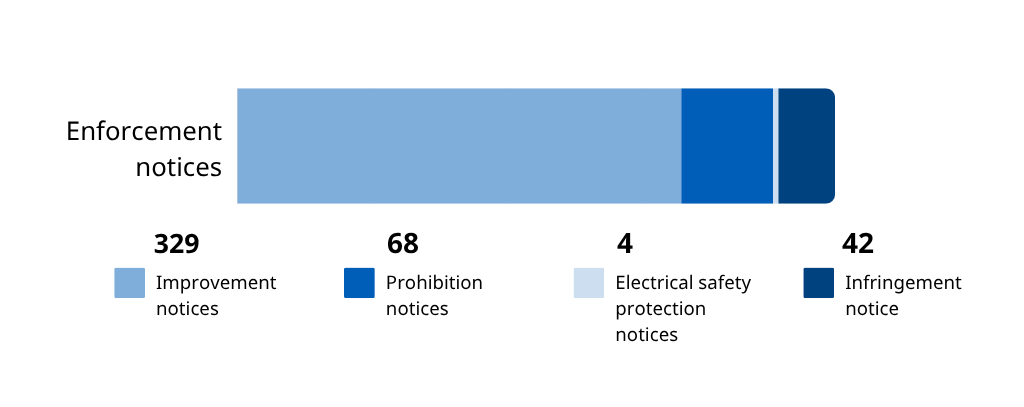
Businesses also fixed a further 290 issues while inspectors were on site.
Inspectors also issued 42 infringement notices.
The table below provides details of the top three most common infringement notices issued.
Section 299(1) Work Health and Safety Regulation 2011 | Persons conducting a business or undertaking (PCBU) failed to ensure that a safe work method statement (SWMS) is prepared before high-risk construction work starts. |
Section 300(1) Work Health and Safety Regulation 2011 | A PCBU failed to put in place arrangements for ensuring that high risk construction work is carried out in accordance with SWMS. |
Section 315F(3) Work Health and Safety Regulation 2011 | The principal contractor for a construction project failed to ensure that site hoarding meets legislative requirements. |
How to keep your workplace safe
To effectively manage risks associated with falling objects on construction sites, it is recommended that businesses take the following actions:
- Implement falling object controls such as exclusion zones, containment screening and hoarding.
- Regularly inspect and maintain scaffolds, and ensure all required components are in place.
- Secure tools and materials to prevent them from falling from height.
- Keep worksites tidy by removing waste and clearing accessways.
Safety is a shared responsibility. Whether you’re an employer, contractor, worker, or a health and safety representative—you play an important role in keeping yourself and others safe.