
Agriculture campaign report (January–March 2025)
Workplace Health and Safety Queensland (WHSQ) conducted an agricultural industry compliance campaign between January and March 2025, focusing on the priority hazard area of overhead powerlines. The campaign aimed to reduce fatalities and serious injuries by increasing industry awareness and assessing work health and safety compliance at agricultural businesses throughout Queensland.
The campaign included two phases: phase one – education and awareness; phase two – inspector activities, including workplace inspections and compliance action.
Phase one - How we shared safety knowledge
Phase one of the campaign focused on education and awareness. We reached approximately 15,000 Queensland businesses by email, sharing targeted information and practical guidance materials.
Following the campaign, we surveyed businesses to understand its effectiveness, impact and long-term value. The following insights are based on 131 survey responses:
- 58% of respondents felt prepared for the audit.
- More than half of the respondents took action after receiving the email, including a review of their safety management systems and discussing the campaign with workers and senior leaders.
- Some businesses also:
- improved electrical compliance across their workplaces
- introduced switchboard testing
- installed markers on overhead powerlines
- conducted workplace audits focused on power poles, powerlines and machinery clearance distances.
Phase two - What we found
Phase two focused on workplace inspections. Inspectors assessed compliance and responded to non-compliance. Between January and March 2025, inspectors conducted 109 inspections of agriculture businesses across Queensland.
To ensure a fair and consistent approach, all assessments were conducted using a standardised audit tool.
Inspectors identified the following common areas of non-compliance:
- Electrical overhead powerlines were not adequately marked to prevent line strikes, particularly in vehicle and traffic areas.
- Electrical installations and equipment were not adequately verified, including non-compliant residual current device testing.
- Electrical switchboards were non-compliant and allowed access to live electrical components, such as missing pole fillers, holes and unsecured panels.
- Electrical equipment was damaged, including damaged electrical leads and deteriorated electrical insulation.
Emergency workplace management
- Emergency management plans were not in place.
- Where plans were in place, they were often inadequate because they:
- lacked evidence of worker consultation
- had not been tested
- did not include sufficient information about contacting emergency services.
Information, training and instruction
- Workers had not received adequate information, training or instruction on working near overhead powerlines.
- Processes were not in place to ensure workers were competent to work near overhead powerlines.
- Procedures were not in place to ensure plant was safe and fully operational before use.
What actions we took
Inspectors issued 131 enforcement notices as part of the campaign.
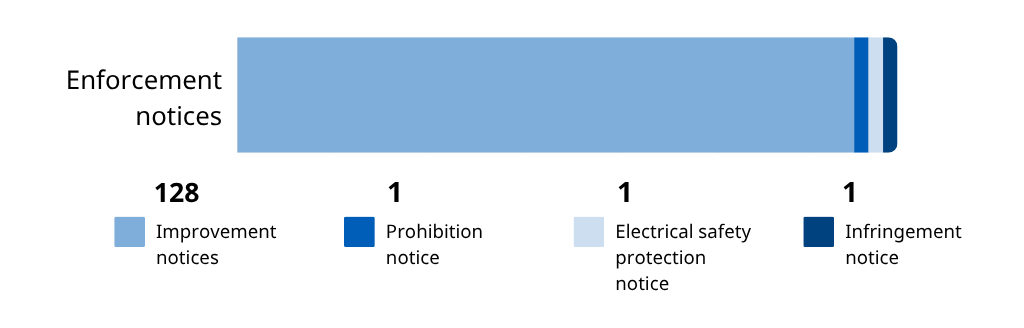
A further 14 non-compliances were rectified while inspectors were on site.
How to keep your workplace safe
To effectively manage risks from overhead and underground powerlines, it is recommended that businesses take the following actions:
- Keep a safe distance from powerlines. Stay outside the exclusion zone, at least three metres from powerlines up to 132 kV and six metres from powerlines up to 330 kV.
- Identify powerline locations before work starts. Check maps, contact the property owner or electricity provider, or access a free safety plan at lookupandlive.com.au.
- Make powerlines and poles easier to see. Obtain approval from the electricity provider before painting power poles or installing markers or flags.
- Educate workers to work safely around powerlines. Ensure workers understand the height and reach of machinery and equipment that could enter exclusion zones (e.g. harvesters, elevated work platforms, irrigation pipes, grain augers, elevators, mobile grain silos, cranes, tippers and excavators can enter exclusion zones).
- Manage trees and vegetation near powerlines. Contact your electrical provider if trees or vegetation are too close to powerlines or could fall into them. Never trim powerlines yourself.
- Avoid planting under powerlines. Do not plant crops, trees or tall vegetation under powerlines.
- Report fallen powerlines immediately. Contact your electricity provider if storms or severe weather bring down powerlines. Do not approach fallen powerlines.
- Tell workers where powerlines are located. Before work begins, make sure workers can identify nearby powerlines and understand the associated risks.
- Use available safety resources. Access guidance for agricultural businesses.
Safety is a shared responsibility. Whether you’re an employer, contractor, worker, or a dedicated health and safety representative—you play a role in keeping yourself and others safe.