
Safe support of mobile plant on outriggers
Last updated: 10 August 2026
Purpose
This safety alert highlights the risk of mobile plant overturning when outrigger feet sink. This alert applies to any mobile plant that uses outriggers or stabilisers, including mobile cranes, elevating work platforms and mobile concrete placing booms.
Background
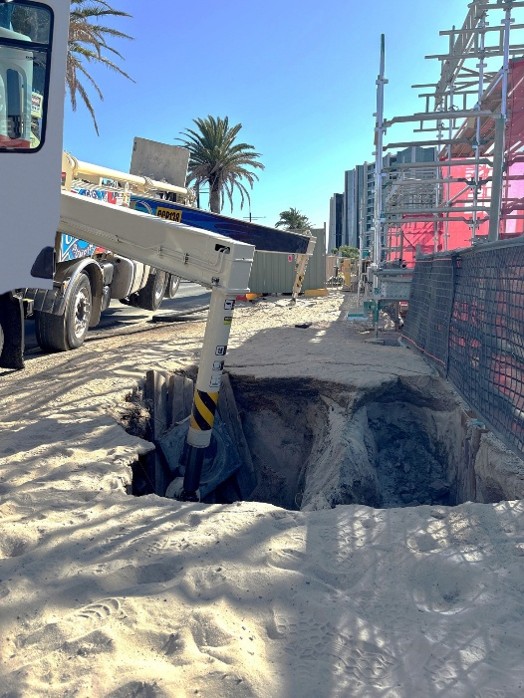
In the first incident in April 2026, a 38-metre mobile concrete placing boom tipped when the front passenger side outrigger punched into a void below the ground (refer to Figure 1).
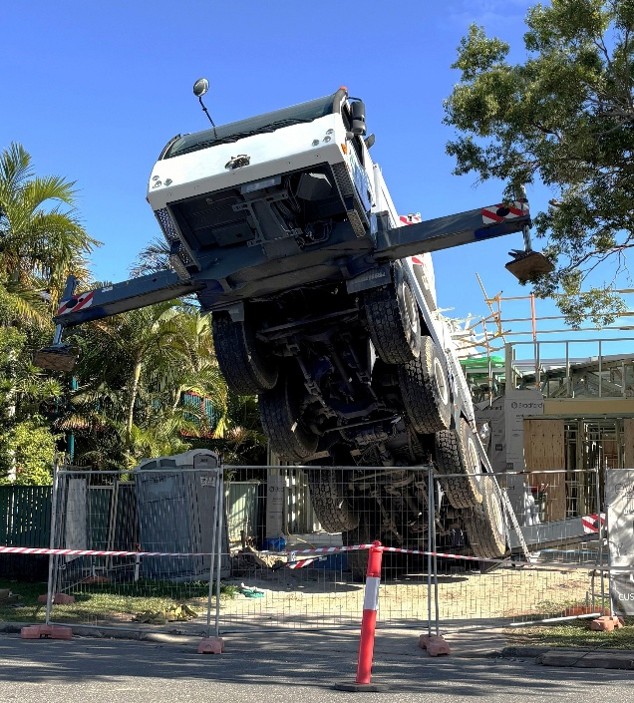
On 4 June 2026, a 70-tonne maximum rated capacity all terrain mobile crane tipped backwards while attempting to lift a pack of roofing sheets to the rear of a house being built (refer to Figure 2).
Contributing factors
Mobile plant on outriggers or stabilisers can overturn due to a number of factors including:
- Timbers or other support pads under outrigger feet being too small for the ground type and condition.
- Ground softened due to water (rainwater or groundwater).
- Underground cavities due to man-made factors (pipes, underground services, covered pits).
- Underground cavities that have been created without anyone being aware of their existence.
The last factor was the most likely cause of the concrete placing boom incident.
The unit had been set up on sand near sheet piles and there was an undetected cavity under the surface.
The workplace had sheet piling installed which created a significant difference in surface levels. Surface drainage and ground water seepage behind sheet pile walls likely caused fines migration — where fine sand is progressively washed through gaps in the wall, creating hidden voids beneath an intact surface crust.
Although the operator took reasonable precautions and set up a large pad under the outrigger foot, he was unaware of the large undetected cavity directly below.
It should be noted that dynamic cone penetrometer (DCP) testing may not identify an underground cavity where the test probe is not long enough to reach the top of the cavity.
Action required
Section 17 of the Work Health and Safety Act 2011 requires persons conducting a business or undertaking (PCBUs) to eliminate risks to health and safety, so far as is reasonably practicable.
Section 19 of the Act provides that PCBUs must ensure, so far as is reasonably practicable, the health and safety of workers including the safe use, handling and storage of plant.
The Mobile crane Code of Practice 2024 (PDF, 2.29 MB) and the Concrete Pumping Code of Practice 2019 (PDF, 2.29 MB) (Concrete pumping CoP) provide detailed information on the safe setup of mobile cranes and mobile concrete placing booms.
Plant suppliers
Companies that supply mobile plant and an operator to a site must ensure the plant is without risk to the health and safety of persons at the workplace. This includes providing adequate tools for operators to do their job safely such as the supply of enough timbers and/or bog mats for various ground types where the mobile plant is to be set up.
Many suppliers of large slewing mobile cranes send out bog mats for the crane on a separate truck as a standard practice, and work under the standard of “no bog mats, no crane”. This is the safest approach and means there are very few overturning incidents involving mobile cranes on outriggers.
Principal contractors and builders
A person conducting a business or undertaking (PCBU), including principal contractors and builders, should provide detailed and accurate information on underground services, including underground pipes, pits, tanks, to the mobile plant operator.
On some sites a geotechnical engineer should be engaged, typically by the principal contractor or builder, to assess the ground where the mobile plant is to be operated (refer to section 8.2.2 of the Code for circumstances where this is standard practice).
When mobile plant is set up on suspended slabs, an engineer is to provide written instructions that detail the locations where the plant can be set up along with other relevant information (e.g. specifications for any required propping).
Ground water (both from rain and tidal areas) can greatly increase the risk of mobile plant overturning. Hard crusts can form on the surface while the ground remains waterlogged underneath. Assessing the effect of water is outside a crane operator’s skill set and advice should be provided by a geotechnical engineer.
On sites where there is a risk of underground cavities forming (e.g. sandy sites where dewatering is occurring) advice on their possible locations should be obtained from a Geotechnical Engineer.
The engineer should then recommend an effective detection method such as ground-penetrating radar (GPR). Ground testing needs to be carried out at the exact location where the mobile plant is to be set up and may require multiple test locations.
As underground cavities could form over time, guidance on the minimum frequency of testing should be obtained from the geotechnical engineer.
Mobile plant operators
Mobile crane and mobile concrete placing boom operators are expected to be able to carry out basic calculations on ground pressure applied by the outriggers of the mobile plant they are operating.
Both the Mobile crane Code of Practice 2024 (PDF, 2.29 MB) and Concrete Pumping CoP (PDF, 2.29 MB) provide information on maximum permissible bearing capacities for some basic ground types. The computers on modern mobile cranes and concrete placing booms may provide downward loads for each outrigger leg so that the required minimum pad size can be calculated.
Using this information, the mobile plant operator can determine the appropriate outrigger pad size to ensure the pressure exerted on the ground is less than the ground’s permissible bearing capacity.
Mobile crane manufacturers generally provide computer programs that enable these factors to be determined before the crane arrives on site.