
Fatal hay bale incident
MAY CONTAIN DISTRESSING CONTENT TO SOME READERS
In 2025, a truck driver died after being struck by falling hay bales. Early investigations indicated the hay bales were being unloaded by a skid steer loader when, for reasons yet to be established, several bales fell on the nearby worker.
Investigations are continuing.
These findings are not yet confirmed, and investigations are continuing into the exact cause.
Safety issues
Working with hay bales is a common activity in the agricultural industry. Bales come in various shapes (e.g. round or rectangular) and sizes. They are made of grass, lucerne, straw, stubble or other plant material that has been compressed, tightly bound or baled together (including wrapped round silage bales).
There are serious health and safety hazards and risks working with hay bales including but not limited to:
- falls from bale stacks
- falls from vehicles and machinery used to transport or stack bales
- being struck by falling or collapsing bales
- trips and falls from loose bale string.
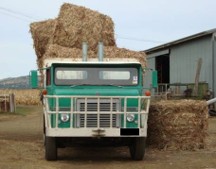
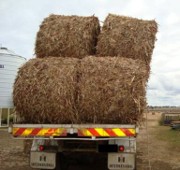
Workers and bystanders are at risk if bales fall or collapse while loading or unloading trucks or trailers. Large round or rectangular bales can weigh up to 800 kilograms. Bales have the potential to fall if:
- they have moved, compressed or collapsed during transit
- they are stacked incorrectly (e.g. round bales stacked on their sides and not on the flat ends, which is the safest method and rectangular bales being incorrectly positioned) or are too high and become unstable, particularly when the individual hay bales making up the stack do not align with one another
- inappropriate lashings, ropes or inadequate securing methods have been used
- there has been removal of restraints, ropes or lashes, allowing unstable bales to fall without warning, particularly when a vehicle is parked on sloping ground
- workers have not been trained to perform the task safely
- bale handling equipment is used that is not properly designed, constructed, and maintained
- they are dislodged during unloading, and fall.
Ways to manage health and safety
Effective risk management starts with a commitment to health and safety from those who manage the business. If an incident occurs, you'll need to show the regulator that you’ve used an effective risk management process. This responsibility is covered by your primary duty of care in the Work Health and Safety Act 2011.
Use the hierarchy of controls to help decide how to eliminate and reduce risks in your place of work. The hierarchy of controls ranks types of control methods from the highest level of protection and reliability to the lowest. It’s a step-by-step approach to eliminating or reducing risks. You must work through the hierarchy of controls when managing risks, with the aim of eliminating the hazard, which is the most effective control.
Further information about the hierarchy of controls and managing risks can be found on the WorkSafe.qld.gov.au website: Managing risks.
Possible control measures to prevent similar incidents
A person conducting a business or undertaking (PCBU) has a duty to ensure workers and others are not exposed to health and safety risks, including the risks associated with powered mobile plant such as forklifts and the loading and unloading of trucks involving hay bales.
In similar situations where hay bales are being unloaded from a truck, a safe system of work to manage the risks of loading and unloading hay bales and the associated risks should be implemented and maintained. This could include, but is not limited to:
- Identify, implement and enforce exclusion zones so no-one places themselves between the load and the truck, trailer or lifting equipment to reduce any possibility of coming into contact with mobile plant and/or a falling load. The size of the exclusion zone should be based on a written risk assessment and clearly marked.
- Separating people from mobile plant using barriers, fences or other similar options. Where it is reasonably practicable, workers and others should not access the loading/receiving area when mobile plant is operating during the load/unload process. Creating dedicated waiting areas for workers (consider a separate area) and ensuring workers and other people don’t leave the area otherwise loading/receiving activities will cease.
- Ensuring the mobile plant and equipment that has been designed for the task (e.g. the use of ‘telehandlers’ or purpose-designed bale handling attachments such as hay bale clamps, grabs and spikes). Ensure the plant and any attachments are used in accordance with the manufacturer’s specifications. Examples include:
- using a self-levelling front-end loader attachment to prevent the bale falling
- a backboard to prevent the bale falling backwards onto the operator.
- Develop safe work procedures for unloading and loading bales. This includes but not limited to ensuring:
- bales are never strapped or unstrapped while the trailer is still being loaded or unloaded
- the loading and unloading sequence is implemented to prevent the load becoming unstable
- the load is inspected prior to unloading to identify any potential movement of materials
- loading or unloading occurs only on level flat ground.
- Providing workers, contractors and others with clear instructions, training and supervision on safe work procedures and processes.
- Training and instruction should be provided by a competent person in an easy-to-understand manner.
- People loading or unloading hay bales need to be experienced, and if not they should be trained in the task and correctly supervised
- PCBU’s have a responsibility to ensure all exclusion zones and unloading processes are communicated, understood and followed by workers and contractors.
- General risk identification and management of risks associated with the task such as overhead powerlines and other vehicular traffic.
Consideration can be given to also using personal protective equipment (PPE) such as high-visibility or reflective clothing.
Administrative control measures and PPE rely on human behaviour and supervision, and used on their own, tend to be least effective in minimising risks. The control measures you put in place should be reviewed regularly to make sure they work as planned.
More information
- Managing the risks of plant in the workplace Code of Practice 2021
- Rural plant Code of Practice 2024
- Working with hay bales
- Managing your drivers' safety at delivery points
- How to manage work health and safety risks Code of Practice 2021
- Load Restraint Guide - NHVR
If this information has caused distress, there are services to help:
- Lifeline – 24/7 crisis support service, including phone, texting and chat services.
- Beyond Blue – information and support for anxiety, depression and suicide prevention for everyone in Australia.
- Black Dog Institute – research and resources on mental health in the workplace.
- SANE – helpline service, as well as resources on mental health.