
Fatal cane rail incident
MAY CONTAIN DISTRESSING CONTENT TO SOME READERS
In October 2025, a locomotive driver's assistant was fatally struck by a moving rake of cane bins at a sugar mill yard during shunting operations. Initial investigations indicate he had left the locomotive to change a set of points during a shunting sequence and was struck by the moving bins a short time later.
Investigations are continuing.
These findings are not yet confirmed, and investigations are continuing into the exact cause.
Safety issues
Common hazards associated with cane rail network operations include but are not limited to:
- contact between trains, head-to-head and head to tail
- contact between trains and other things (e.g. vehicles, plant, people and animals)
- de-railing and re-railing
- shunting
- yard shunting (other than by locomotives such as push tractors and winches).
Shunting involves moving a train from the main line to a siding, or from one line of rails to another. This includes the collection or delivery of cane bins from a rake of cane bins on a train at the sugar mill, or at sidings or loops throughout the cane rail network.
Shunting activities introduce a range of hazards due to the following factors:
- Shunting may involve the entry between bins or bin and locomotive to couple or uncouple an existing rake, to another rake or to the locomotive.
- The worker uncoupling the bins is sometimes not in visual contact with or visible by the operator.
- Shunting takes place during day and night operations in a range of work environments.
- While shunting, bins can be temporarily left on the main line.
- Unless secured, bins can move unexpectedly and can travel for long distances driven by wind and/or gravity.
- Rope or slings being used in shunting may ‘snapback’ when under tension causing a risk of injury to workers.
Ways to manage health and safety
Effective risk management starts with a commitment to health and safety from those who manage the business. If an incident occurs, you will need to show the regulator that you have used an effective risk management process. This responsibility is covered by your primary duty of care in the Work Health and Safety Act 2011.
Use the hierarchy of controls to help decide how to eliminate and reduce risks in your place of work. The hierarchy of controls ranks types of control methods from the highest level of protection and reliability to the lowest. It is a step-by-step approach to eliminating or reducing risks. You must work through the hierarchy of controls when managing risks, with the aim of eliminating the hazard, which is the most effective control.
Possible control measures to prevent similar incidents
A person conducting a business or undertaking (PCBU) has a duty to ensure workers and other people are not exposed to health and safety risks, including the risks associated with cane rail operations. Planning and design of new rail installations should include consideration of issues such as access for maintenance of trackside areas and installations that encourage safe practices.
Fly shunting is prohibited (uncontrolled movement of bins).
Loose shunting (bins are loose but are under control) should only be used following a risk assessment and implementation of appropriate controls.
This risk assessment should be documented and incorporated into work instructions that are rigorously audited. Rail operators should develop shunt plans. All shunting activities involving propelling movements should be assessed for any additional risks of collision and/or striking others.
Adequate lighting should be provided in areas that are used on a regular basis during the night, for example: full and empty yards, trans-loaders; and marshalling yards.
Safe systems of work
A safe system of work should be implemented to manage the risks associated with cane railway operations. This could include, but is not limited to the following:
- Ensuring no work takes place between bins while the bins or the locomotive is moving (exclusion zone). Workers should not walk within the profile of the track whilst shunting, particularly when protecting propelling movements. Instead, walkways (‘safe places’) or exclusion zones should be used.
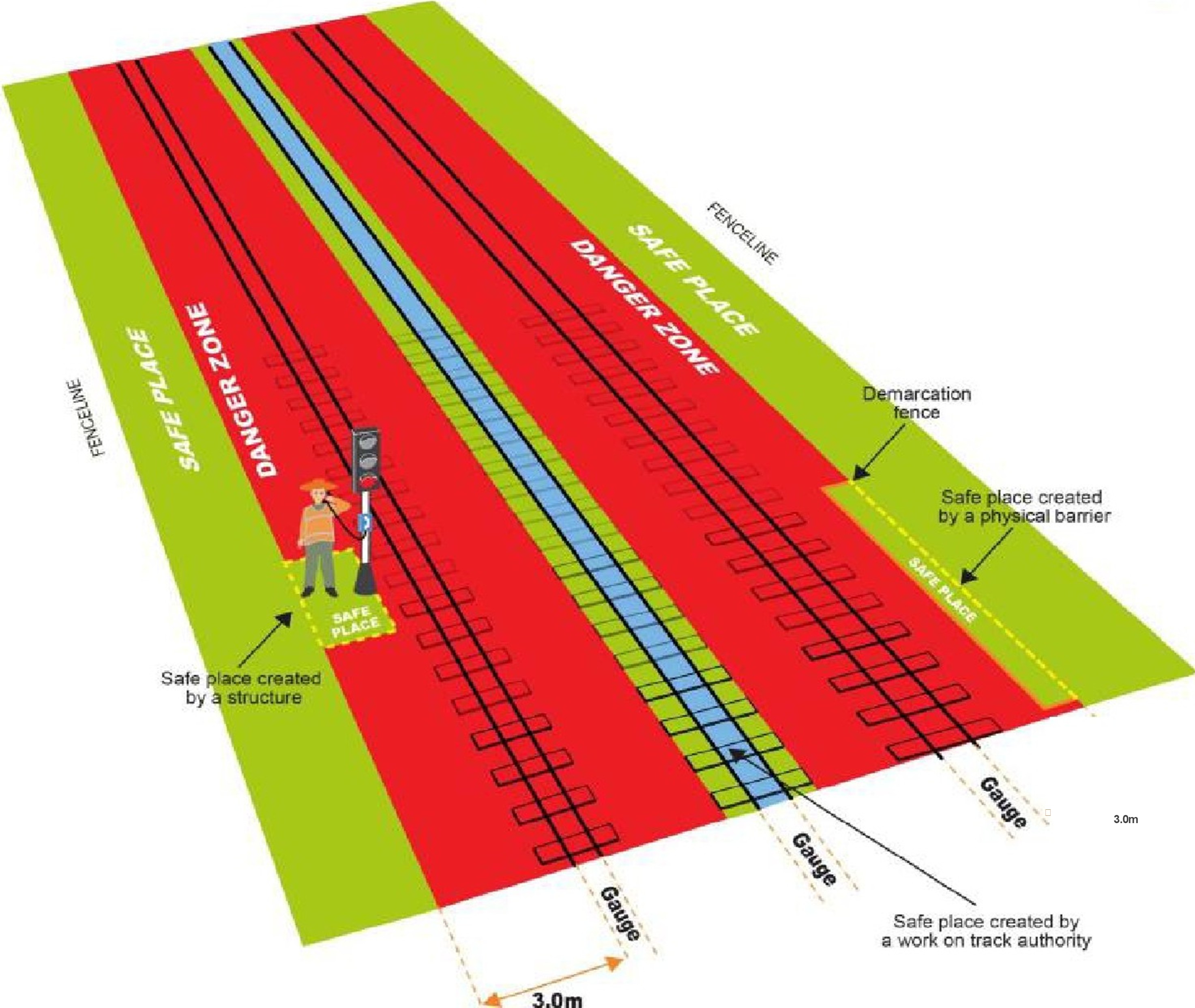
Figure 1: Danger Zones and Safe Places
Note: In certain circumstances, the distance from the danger zone to the safe place is 2.5 metres (not 3 metres).
- Workers and others involved in shunting activities should remain in the line of sight of driver until the train is stationary. Ropes should only be used for loose shunting when no other option is reasonably practicable and after a risk assessment which identifies appropriate controls. Workers should maintain an exclusion zone to be outside of the snapback zone when loose shunting.
- Safe work procedures must be developed to ensure processes are in place and understood regardless of whether there are direct communications available between rail crew and others. Training for workers must include recognition of the danger zone, and how to apply continual vigilance when undertaking shunting activities.
- Adequate and appropriate training is a requirement for managing the risks associated with cane rail operations. Training should cover the specific hazards, risks and controls associated with jobs or tasks that are carried out by the worker receiving the training. The training should be appropriate to the type of work to be performed.
- For rail networks that have single driver operations, sidings and yards must be risk assessed to ensure shunting procedures do not reduce loco driver visibility.
- When leaving cane bins in sidings or on the main line while shunting, ensure they are restrained so that they cannot move in any direction. This is normally achieved using brake wagons, chocks or mechanical restraints.
- Ensuring maintenance of trackside areas, including vegetation control, levelling, removal of trip hazards and covering of drains.
- PCBU’s must also consult with workers whose health and safety is likely to be affected (consultation must be regular and ongoing).
- Ensuring any environmental risk factors – ground conditions, terrain, weather (including seasonal changes) have been considered and assessed.
- For locomotive crews involved in shunting activities they must:
- never jump off a locomotive - always dismount by stepping off
- not access or egress from a locomotive unless travelling at a speed of walking pace or less, and crew are trained to access and egress at this speed
- move briskly but not run
- not ride on cane bins
- not cross the path of a moving locomotive or cane bins
- when stepping from the locomotive, leave on the side on which the work is to take place. If the operator is required to depart the locomotive it should be at a stop and brakes applied
- ensure they remain visible to other relevant workers
- ensure walkways for shunting activities are maintained
- ensure a five-metre separation distance for people in front of and behind plant on the corridor.
- Other shunting movement controls should involve the use of multiple communication methods such as:
- voice radio communication
- hand signals
- torch signals
- headlight signals
- locomotive horn codes
- documented shunting procedures for generic and specific sidings.
Any remaining risk must be minimised with suitable personal protective equipment (PPE). For example, use of hard hats, steel cap boots and high-visibility vests.
Administrative control measures and PPE rely on human behaviour and supervision. If used on their own, they are least effective in minimising risks. The control measures you put in place should be reviewed regularly to make sure they work as planned.
More information
- Cane rail safety 2024 supplement to the Sugar mill safety Code of Practice 2024 (PDF, 0.98 MB)
- Sugar mill safety Code of Practice 2024 (PDF, 0.86 MB)
- Work health and safety consultation, co-operation and co-ordination Code of Practice 2021 (PDF, 0.54 MB)
- Preventing and managing fatigue-related risk in the workplace (PDF, 1.45 MB)
If this information has caused distress, there are services to help:
- Lifeline – 24/7 crisis support service, including phone, texting and chat services.
- Beyond Blue – information and support for anxiety, depression and suicide prevention for everyone in Australia.
- Black Dog Institute – research and resources on mental health in the workplace.
- SANE – helpline service, as well as resources on mental health.
Have you been affected by a workplace fatality, illness or serious injury?
For advice and support: