
Assessment for the Degree of Permanent Impairment
For workers injured from 15 October 2013, their injuries will be assessed using the Guidelines for Evaluation of Permanent Impairment (PDF, 2.05 MB) (the Queensland Guide).
For psychological and psychiatric injuries, the assessment for the Degree of Permanent Impairment (DPI) must be conducted by the Medical Assessment Tribunals (MATs). There is no review process for these assessments. Further details on the review process are set out below.
The DPI assessment will be issued to a worker in the form of a Notice of Assessment (NOA), once all injuries are assessed. Where an assessment has been reviewed then any new DPI assessment replaces the previous assessment.
Where the injury has not been assessed by a MAT, a worker must respond to the NOA within 20 business days if they do not agree with the DPI assessment and require a fresh assessment.
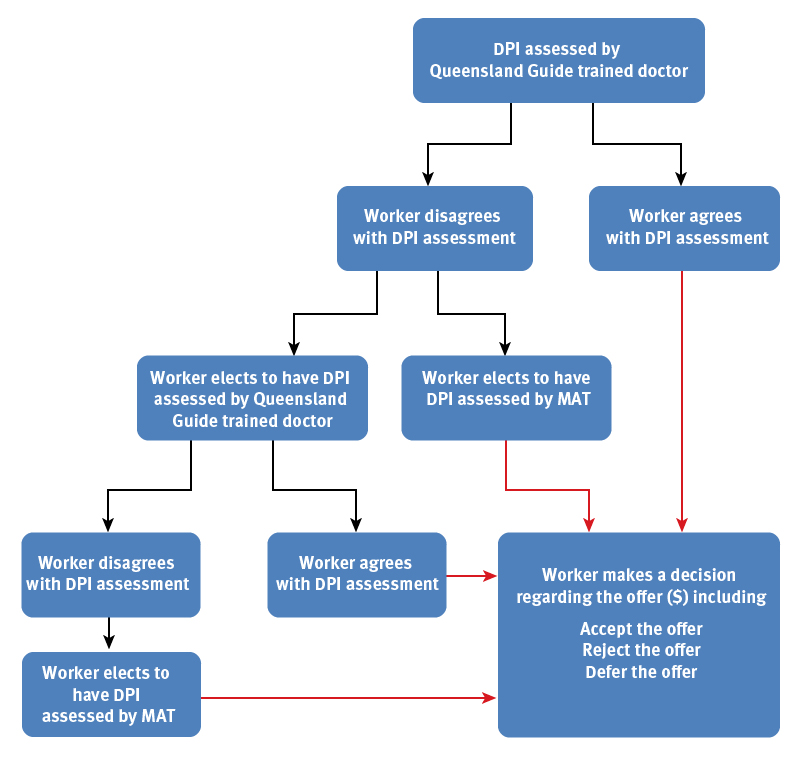
For physical injuries, if a worker disagrees with the original assessment by a Queensland Guide trained assessor, they can request referral to the MAT or ask their insurer to consider a medical review by a different trained assessor. An insurer is required to decide within 10 business days of receiving the NOA response whether to have the injury re-assessed by a different doctor or refer it to the MAT.
Outlined below are the steps for arranging an assessment of DPI and responding to a request for a new assessment.
What is sent to the doctor and/or MAT
An insurer will send appropriate material from the worker's claim file to the trained assessor and/or MAT to enable assessment of the DPI. The claim file will include:
- initial application form or computer-generated form if the application was made over the phone
- all medical and rehabilitation reports and records relevant to the injury
- additional “relevant documents” as required by Section 499 and Section 510C of the Workers’ Compensation and Rehabilitation Act 2003 to be provided to the MAT.
Choosing a Queensland Guide trained assessor
If a worker disagrees with the initial assessment of DPI, they have the option to nominate a trained assessor to conduct a fresh assessment of DPI.
An insurer will only agree to refer a worker for an assessment of DPI if the assessor:
- has completed training in the Queensland Guide, and
- is from the relevant specialty based on the worker's injuries, and
- has availability to conduct the assessment and provide their report within 2 months of the worker making the request, and
- agrees to provide their assessment and report in accordance with the Queensland Guide and for the fees provided in WorkCover Queensland’s Table of Costs.
View the register of permanent impairment trained assessors (XLSX, 0.25 MB).
Process for responding to DPI for Physical Injuries
Process for responding to DPI for Psychological and Psychiatric Injuries
For psychological and psychiatric injuries, the assessment must be conducted by the MAT. Only the MAT can decide a degree of permanent impairment for a psychological injury.
The MAT is independent from insurers and is administered by Workers’ Compensation Regulatory Services (WCRS). The MAT consists of a panel of three or five doctors who specialise in a type of injury. The MAT doctors make a decision using the information provided by a worker and their insurer, as well as from the medical examination and interview at a worker’s tribunal hearing. A written tribunal decision will be provided to a worker after the hearing. It will include the information considered by the MAT doctors and their reasons for making the decision.
MAT decisions are final. There is no review process for these assessments.
A worker can only dispute a MAT’s decision by:
- asking their insurer to consider new medical evidence up until 12 months after their hearing
- making an application for judicial review to the Supreme Court.
If a worker would like to submit new medical evidence, they should discuss this with their insurer, who will submit the information to WCRS.
A judicial review is a dispute against the process followed by the tribunal and doesn’t consider the medical matters of the decision. It requires a worker to establish that there was a breach of procedural fairness or an error of law in the decision making. It is recommended a worker seeks independent legal advice on this option.